Updated on September 23, 2026 by canadian immigration experts
If you are applying through the Alberta Advantage Immigration Program (AAIP), the first question on your mind is almost always the same: how long will it take? The honest answer is that AAIP processing times are not a single fixed number. They depend on which stream you apply to, how complete your file is, how many people are in the queue ahead of you, and — increasingly in 2026 — how many nomination spaces Alberta has left for the year. This guide breaks down the current AAIP processing time by stream, explains the 2026 federal allocation cuts that are reshaping timelines, and shows you exactly what to expect at each step.
Remember that AAIP is only the first stage. A provincial nomination is not permanent residence — once Alberta nominates you, you still apply to Immigration, Refugees and Citizenship Canada (IRCC) for PR, and that federal step has its own separate timeline.
What Is the Current AAIP Processing Time in 2026?
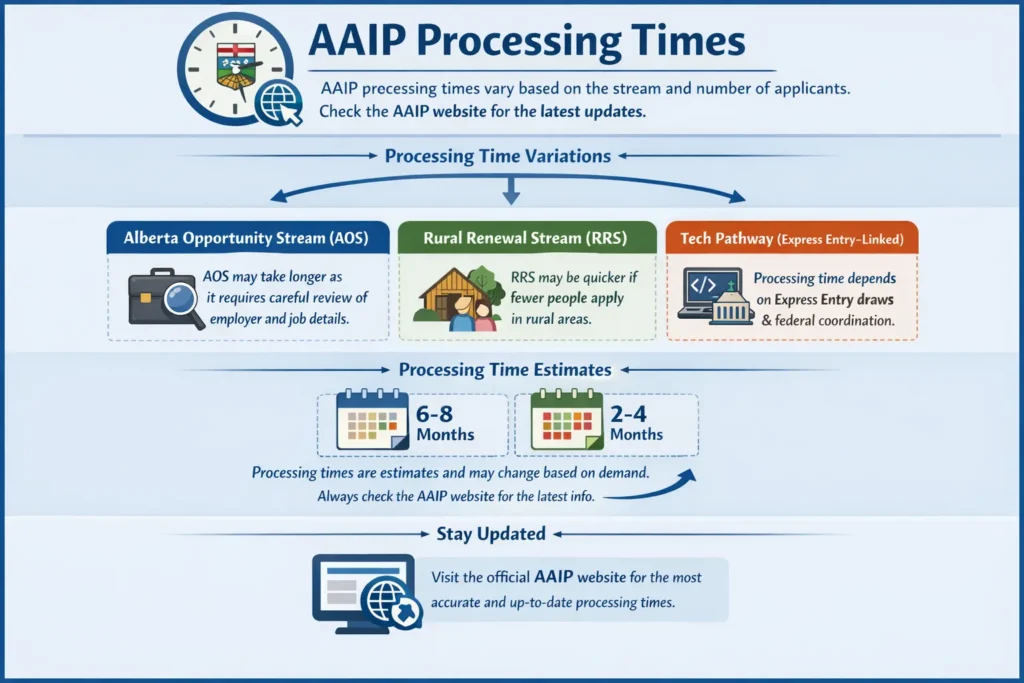
Alberta publishes a live processing dashboard rather than a fixed service standard, so the fairest way to read AAIP processing times is by looking at how far back the province is currently assessing each stream. According to the official Alberta.ca processing information page, as of late August 2026 the province was working through applications received several weeks to a few months earlier, depending on the stream.
In broad strokes, as of September 2026 a straightforward AAIP nomination decision typically takes 3–6 months from the date you submit a complete application. Fast-tracked pathways such as the Accelerated Tech Pathway and the Dedicated Health Care pathways can move in a matter of weeks, while the high-volume Alberta Opportunity Stream sits at the longer end. These are estimates, not promises, and they shift as Alberta manages its annual nomination cap.
AAIP Processing Times by Stream (2026)
Because each stream has different volumes and verification requirements, the AAIP processing times vary widely. The table below combines Alberta’s published inventory (as of August 25, 2026) with realistic nomination-stage timelines observed in 2026. Always confirm the live figures on the province’s dashboard before you plan.
| AAIP Stream / Pathway | Applications in inventory (Aug 25, 2026) | Currently assessing files received by | Typical nomination-stage timeline |
|---|---|---|---|
| Alberta Opportunity Stream (AOS) | ~530 | May 9, 2026 | ~3–6 months (highest volume) |
| Alberta Express Entry Stream — Priority Sectors | ~256 | May 5, 2026 | ~3–5 months |
| Alberta Express Entry Stream — Accelerated Tech Pathway | ~189 | May 30, 2026 | ~1–2 months (fast-tracked) |
| Dedicated Health Care Pathways | ~42 | July 10, 2026 | Often under 1 month |
| Rural Renewal Stream (RRS) | ~94 | July 9, 2026 | ~2–4 months (plus community endorsement) |
| Tourism & Hospitality Stream | ~7 | July 14, 2026 | ~2–4 months (low volume) |
| Alberta Express Entry — Law Enforcement Pathway | Fewer than 10 | — | Varies (very low volume) |
| Entrepreneur / Farm & business streams | ~217 | Assessed on receipt | ~6–12 months |
Source: Alberta.ca AAIP processing information, inventory as of August 25, 2026. “Timeline” figures are 2026 estimates for the provincial nomination stage only and exclude the federal PR step.
Why the fast streams are fast
The Accelerated Tech Pathway and Dedicated Health Care pathways carry small inventories and target occupations Alberta urgently needs, so files clear quickly. For candidates with an active federal profile, the Alberta Express Entry Stream is often the quickest overall route because it stacks a 600-point CRS boost onto a faster federal PR timeline.
How the 2025–2026 Federal PNP Cuts Affect AAIP Timelines
The single biggest change to AAIP processing times in 2026 has nothing to do with paperwork — it is Ottawa’s decision to shrink Provincial Nominee Program allocations nationally. IRCC cut PNP spaces sharply for 2025 and held them low into 2026, and Alberta felt the squeeze directly.
- Alberta’s 2026 allocation opened at 6,403 nomination spaces. On August 10, 2026, IRCC granted the province an additional 200 spaces, lifting the total to 6,603 for the year.
- As of August 19, 2026, roughly 4,560 nominations had been issued, leaving about 2,043 spaces for the rest of 2026.
- Nominations for eligible physicians and Francophone candidates who meet federal criteria do not count against the 6,603 cap, freeing more room in the general streams.
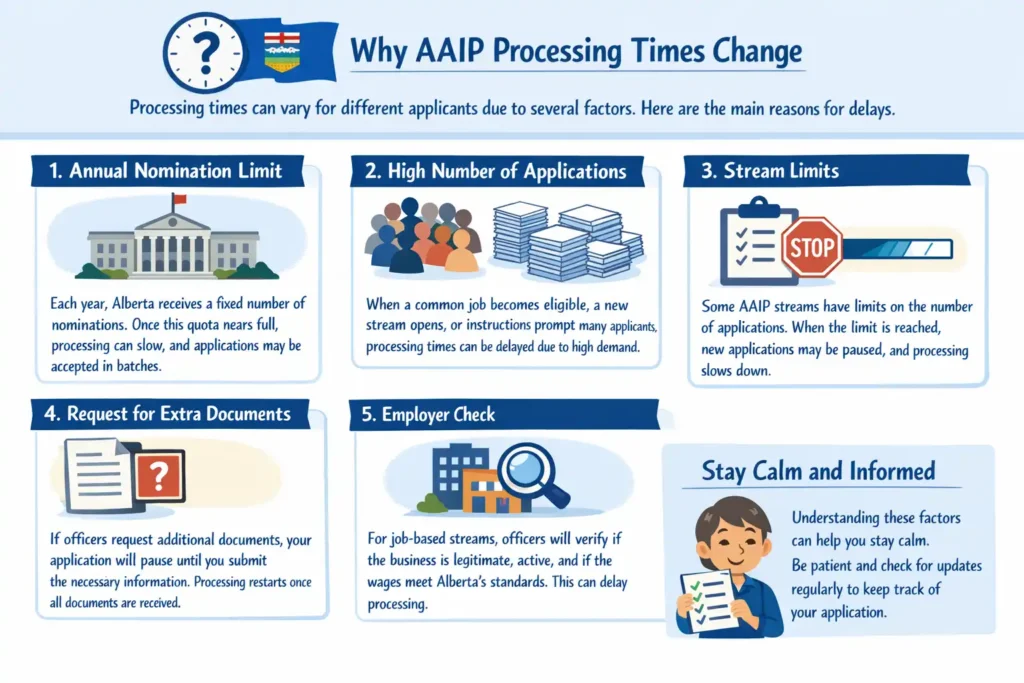
A smaller pie means Alberta must ration nominations more tightly. In practice this shows up as higher and more selective Expression of Interest (EOI) cut-off scores, more targeted draws by occupation, and periods where a stream slows while the province protects its remaining spaces. It does not usually mean your individual file is processed more slowly once it is picked up — but it can mean a longer wait to be invited in the first place, and a real risk that files bump into the following year’s allocation if the cap fills.
What Happens During AAIP Processing?
Understanding the stages helps explain where the time goes and where delays creep in.
1. EOI submission and invitation
You first submit an Expression of Interest and receive a score out of 100. Alberta then holds periodic draws and issues invitations to the highest-ranked, best-fit candidates for each pathway. Time in the pool before an invitation is not “processing” — it depends entirely on draw frequency and cut-off scores.
2. Application submission and completeness check
Once invited, you submit the full application. Officers first confirm it is complete — forms signed, fees paid, valid language results, and employer documents attached. A missing item triggers a request that can add weeks.
3. Eligibility assessment
This is usually the longest step. An officer verifies your work experience, NOC/TEER classification, wage against Alberta standards, and — for job-based streams — that your employer is genuine and compliant. Employer verification is a common source of added time.
4. Nomination decision
If everything checks out, Alberta issues a nomination certificate. If concerns remain, the officer may request more information before deciding.
5. Federal permanent residence stage
After nomination you apply to IRCC. Express Entry candidates gain 600 CRS points and generally see PR processed in about 6–7 months; non-Express Entry (base PNP) applicants apply on paper/online through a separate stream that can take roughly 13–19 months. Always check the current IRCC PNP processing time for your category.
Provincial vs Federal Timeline: The Full Picture
Add the two stages together and most applicants should plan for a total of roughly 12–22 months from AAIP submission to landing as a permanent resident, depending on stream and whether they go through Express Entry.
| Stage | Express Entry route | Non-Express Entry (base) route |
|---|---|---|
| AAIP nomination | ~1–5 months | ~3–6 months |
| Federal PR (IRCC) | ~6–7 months | ~13–19 months |
| Approximate total | ~7–12 months | ~16–22 months |
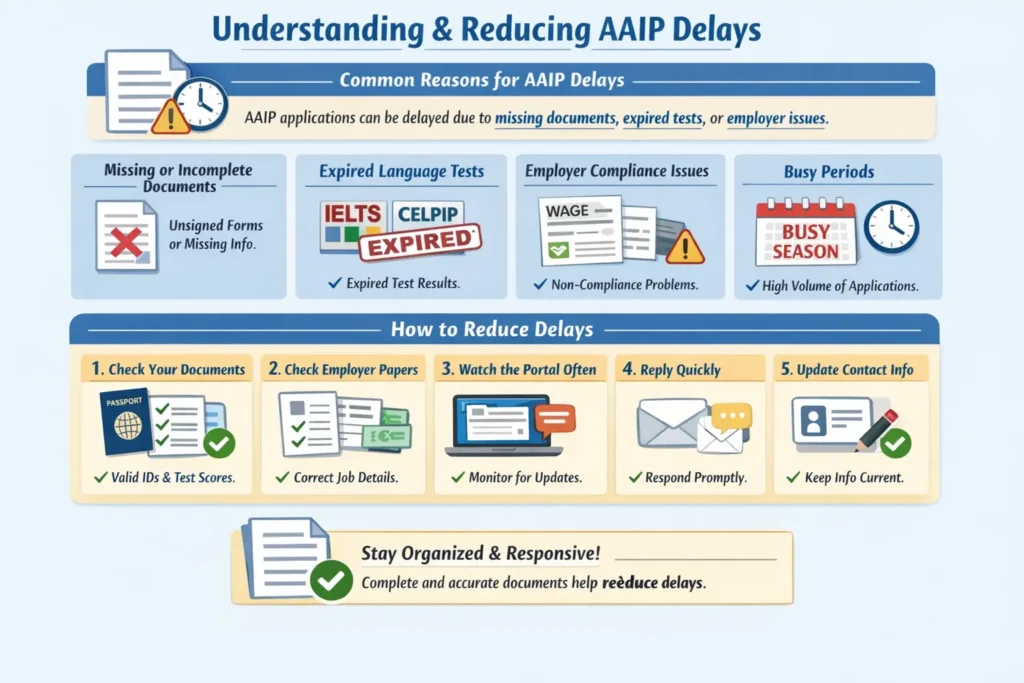
Common Reasons for AAIP Delays
- Incomplete or unsigned documents — missing pay records, forms, or job details.
- Expired language tests — IELTS or CELPIP results that lapse mid-process.
- Employer compliance checks — wages or duties that do not match provincial standards trigger extra verification.
- High application volume in a popular occupation or newly opened stream.
- Annual cap pressure — as Alberta nears its 6,603-nomination limit, some files pause until the next allocation.
How to Reduce Delays
- Submit a complete file the first time. Double-check that passports, language tests, and employer letters all align with your NOC/TEER.
- Confirm employer documents. Wages, duties, and business details must be accurate and current.
- Monitor your portal. Respond to document requests within days, not weeks.
- Keep contact details updated so you never miss a request.
- Apply strategically. Where you qualify for a fast pathway (tech or health care), it can dramatically shorten your wait.
These steps prevent avoidable pauses; they cannot speed up an officer’s review, but a clean file is the single biggest thing within your control.
Frequently Asked Questions
What is the current AAIP processing time in 2026?
As of September 2026, a complete AAIP application typically takes about 3 to 6 months to reach a nomination decision, depending on the stream. Fast-tracked pathways such as the Accelerated Tech Pathway and Dedicated Health Care pathways can be decided in a matter of weeks, while the high-volume Alberta Opportunity Stream sits at the longer end.
Which AAIP stream is the fastest to process?
The Dedicated Health Care pathways and the Alberta Express Entry Accelerated Tech Pathway are generally the fastest, often processing in under one to two months because they carry small inventories and target urgently needed occupations. The Alberta Express Entry Stream is also the quickest overall route to PR because it adds 600 CRS points and a faster federal timeline.
How did the 2025 to 2026 federal cuts affect AAIP timelines?
Ottawa reduced Provincial Nominee Program allocations nationally, and Alberta’s 2026 allocation opened at 6,403 spaces before IRCC added 200 more in August 2026 for a total of 6,603. Fewer spaces mean more selective draws and higher cut-off scores, and files can be delayed into the next year if the annual cap fills.
Does an AAIP nomination mean I have permanent residence?
No. A provincial nomination only means Alberta has approved you at the provincial stage. You must still apply to IRCC for permanent residence, which is a separate step with its own timeline of roughly 6 to 7 months for Express Entry cases and up to 13 to 19 months for non-Express Entry applications.
How long is the full timeline from AAIP to permanent residence?
Most applicants should plan for roughly 12 to 22 months in total from AAIP submission to landing as a permanent resident. Express Entry-linked applicants are usually at the shorter end, while non-Express Entry base applicants are at the longer end.
Can I do anything to speed up my AAIP application?
You cannot control an officer’s review speed, but you can prevent delays by submitting a complete and accurate file, keeping language tests valid, confirming employer documents, and responding to any requests within days. Choosing a fast pathway where you qualify, such as tech or health care, can also shorten your wait significantly.
How Jane Katkova & Associates Can Help
Choosing the right AAIP stream and submitting a flawless application is the surest way to avoid delays and to compete for a nomination while spaces are tight. Our team has guided applicants through Alberta’s programs since 1995 — book a consultation or call +1 416-661-4487 to build a strategy around the current allocation and the fastest pathway you qualify for.
This article is general information, not legal advice. Immigration rules change frequently; confirm current requirements with the relevant authority or a licensed professional.