
Updated on September 23, 2026 by canadian immigration experts
The LMIA processing time is one of the biggest unknowns for any Canadian employer trying to hire a foreign worker — and for any worker whose job offer depends on that approval. A Labour Market Impact Assessment (LMIA) is the document Service Canada issues to confirm that hiring a temporary foreign worker will not harm the domestic labour market. Because the timeline varies so widely between programs, a realistic answer to “how long does an LMIA take?” is never a single figure — it is a range that shifts every month and differs sharply by stream.
This guide is the complete 2026 reference: what an LMIA is, the current LMIA processing times stream by stream, what actually drives delays, how to move faster where the rules allow, and how the 2024–2026 low-wage reforms and British Columbia’s labour-market rules affect your file. For the freshest month-to-month figures on their own, see our latest LMIA processing time snapshot.
What Is an LMIA and Why Does It Matter?
An LMIA is a labour-market test administered by Employment and Social Development Canada (ESDC) through Service Canada. Before most employers can hire a foreign national, they must prove they advertised the role, could not find a suitable Canadian citizen or permanent resident, and are offering wages and conditions consistent with the local market. A positive LMIA (sometimes called a confirmation letter) allows the worker to apply for a work permit; a negative LMIA does not.
The LMIA sits at the front of a longer chain. The processing time you see published by ESDC is only the assessment step — after a positive LMIA is issued, the worker still has to apply for and receive a work permit through IRCC, which is a separate queue with its own timeline. Understanding where the LMIA fits helps employers and workers plan start dates realistically. For the employer-side requirements that precede the assessment, see our overview of LMIA employer requirements, and for the permit stage, our Work Permit services.
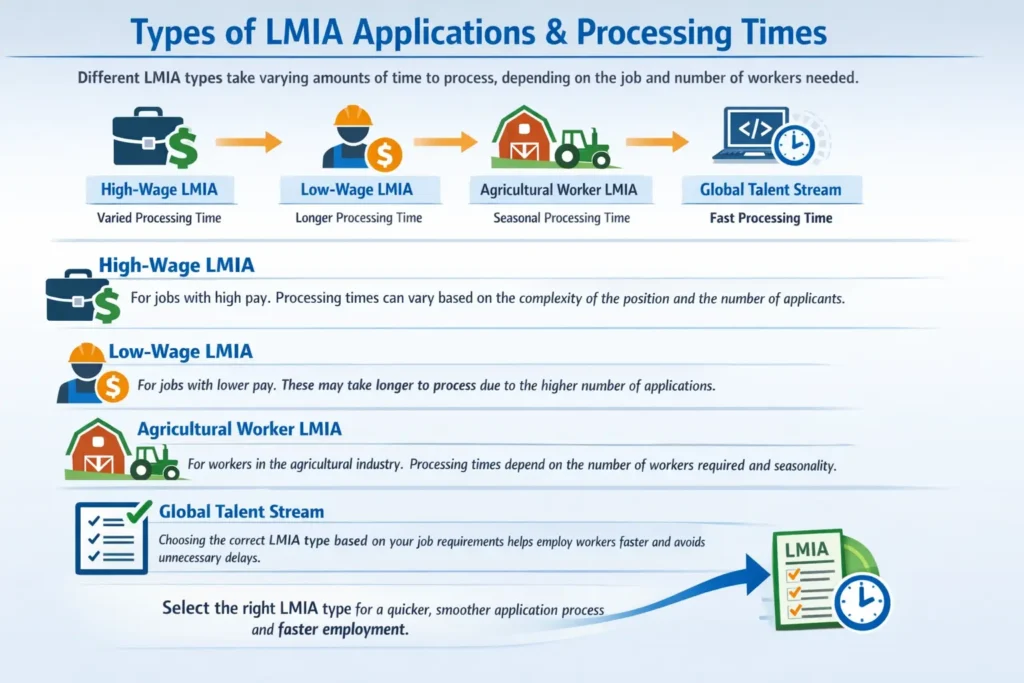
LMIA Processing Times by Stream (2026)
ESDC publishes average LMIA processing times for each stream and refreshes them roughly monthly based on files completed the previous month. The figures below are averages across all Service Canada processing centres — not guarantees — and reflect the update published on August 7, 2026 (covering applications processed in July 2026).
| LMIA stream | Avg. processing time (as of Aug 2026) | Who it is for / notes |
|---|---|---|
| Global Talent Stream (GTS) | ~10 business days | Eligible high-skill tech and specialized occupations; ESDC targets a 10-business-day service standard. |
| Seasonal Agricultural Worker Program (SAWP) | ~8 business days | Seasonal primary-agriculture roles from participating countries; fastest stream. |
| Agricultural stream | ~23 business days | Non-seasonal primary agriculture; timelines rose notably through 2026. |
| Permanent Residence stream | ~86 business days | LMIAs that support a permanent-residence (e.g. Express Entry) application; volatile month to month. |
| Low-wage stream | ~73 business days | Positions below the provincial/territorial median wage; subject to the 2024–2026 reforms below. |
| High-wage stream | ~88 business days | Positions at or above the provincial/territorial median wage; the slowest stream in mid-2026. |
Source: ESDC / Service Canada published LMIA processing times, as of the August 7, 2026 update. Figures are averages and change monthly.
Two things stand out in 2026. First, the “fast” streams (GTS and SAWP) remain genuinely fast, close to their service standards. Second, the high-wage and low-wage streams — which cover most ordinary hiring — have drifted upward through the year, with the high-wage stream reaching roughly 88 business days in the August update. If your role falls in one of these streams, plan for months, not weeks.
What Affects Your LMIA Processing Time?
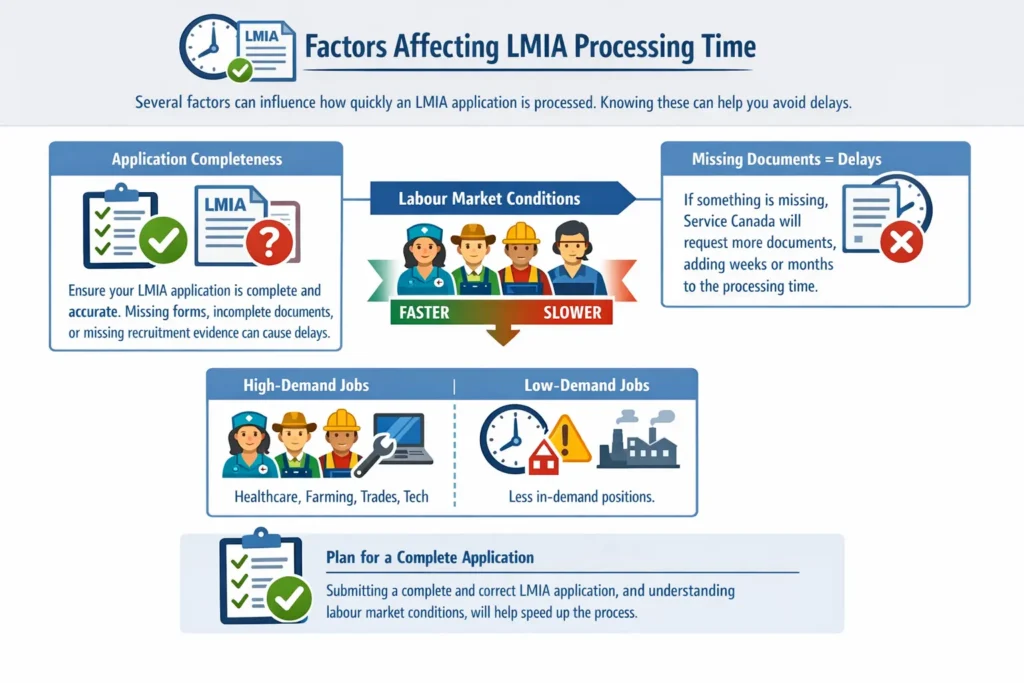
Two identical-looking applications can clear at very different speeds. The main variables are:
- Which stream you file under. This is the single biggest factor, as the table shows — a GTS file and a high-wage file are on completely different clocks.
- Application completeness. Missing recruitment records, an incomplete transition plan, wage documentation gaps, or an unsigned form can push a file to the back of the queue or trigger a request for more information.
- Recruitment and advertising compliance. ESDC checks that you advertised correctly for the required period and considered qualified Canadians and permanent residents first.
- Employer compliance history. Employers with prior TFWP compliance issues, or those flagged for inspection, can face additional scrutiny.
- Local labour-market conditions. Wage levels, regional unemployment, and whether the occupation is in demand all feed the assessment — and, for low-wage roles, whether the region is even open to processing at all.
- Application volume. Processing centres see seasonal surges; the published averages move up and down partly for this reason.
The 2024–2026 Low-Wage LMIA Reforms
If you are hiring for a low-wage position, the rules changed substantially and continue to tighten. These reforms do not just affect processing time — in many regions they determine whether an application is accepted at all. As of 2026, the key measures are:
- Refusal to process in high-unemployment areas. Since September 26, 2024, ESDC will not process low-wage LMIA applications in a Census Metropolitan Area (CMA) with an unemployment rate of 6% or higher. The list is reviewed roughly every three months; the next scheduled update is October 9, 2026.
- Sector exceptions. The refusal-to-process rule carves out certain roles — primary agriculture and food security (food and fish processing), construction, and healthcare — which may still be processed even in a restricted CMA.
- Lower workforce cap. Where low-wage LMIAs are allowed, most employers can fill no more than 10% of their workforce at a given location with low-wage temporary foreign workers. Construction and healthcare retain a higher 20% cap.
- Shorter LMIA validity. An LMIA is now generally valid for six months from issuance (reduced from twelve), so the worker must apply for a work permit within that window.
- Shorter employment duration. The maximum duration of employment under a low-wage LMIA was reduced to one year (from two).
- Program cap. The federal government has continued to scale back the Temporary Foreign Worker Program overall as part of its 2025–2026 immigration-levels planning, tightening low-wage intake nationally.
The practical takeaway: for a low-wage role, confirm your CMA is open before you invest in recruitment, because a refusal to process is not the same as a refusal on the merits — the file is simply returned without assessment.
LMIA Processing Time in British Columbia
British Columbia employers use the same national LMIA streams and the same ESDC processing centres, so BC processing times track the national averages in the table above. What differs is BC’s exposure to the low-wage refusal-to-process rule. On April 10, 2026, ESDC added the Vancouver CMA to the list of regions where low-wage LMIAs will not be processed after Vancouver’s three-month unemployment rate reached about 6.5%. That status is reassessed at each quarterly review, so a region that is closed today can reopen — and vice versa.
BC employers should also remember that an LMIA can support a Provincial Nominee application through the BC PNP’s Skills Immigration and other streams. Because the refusal-to-process rule targets the low-wage stream, high-wage, GTS, and PR-supporting applications in BC generally remain open even when the low-wage stream in a given CMA is paused. Always confirm the current CMA list before advertising.
When You May Not Need an LMIA at All
The fastest LMIA is sometimes the one you do not need. A large number of work permits are LMIA-exempt under International Mobility Program categories — intra-company transfers, certain trade-agreement professionals (such as CUSMA), reciprocal-employment arrangements, and roles that create a significant benefit for Canada. In those cases, the employer submits an offer of employment through the Employer Portal and pays the compliance fee instead of running a full labour-market test, which can save months.
Before assuming you need an LMIA, it is worth checking whether an exemption applies to your situation. Our guide to LMIA-exempt work permits and reciprocal employment explains the main categories. Where no exemption fits, the streams and timelines above are your roadmap.
How to Speed Up LMIA Processing (Where Possible)
You cannot change ESDC’s published averages, but you can avoid the delays that push files to the slow end of the range:
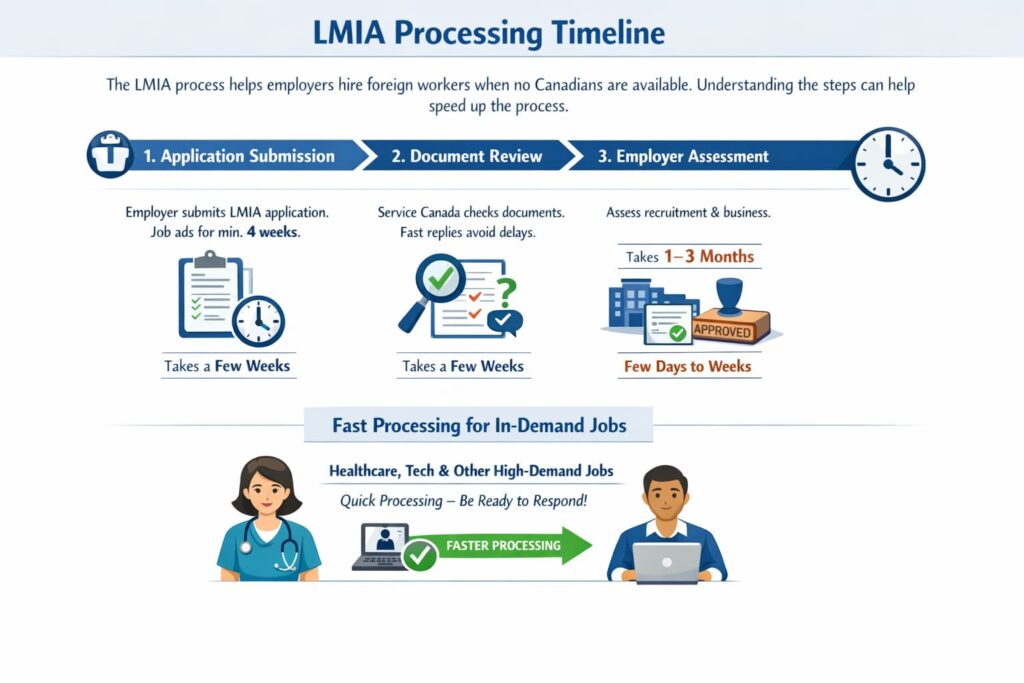
- File under the fastest eligible stream. If the role and worker qualify for the Global Talent Stream, the difference is dramatic — roughly 10 business days versus months for a standard high-wage file.
- Submit a complete, accurate package. Include full recruitment and advertising evidence, correct wage data, a compliant job offer, and (for GTS) a Labour Market Benefits Plan. Completeness is the delay you control most directly.
- Advertise correctly and early. Meet the minimum advertising duration and channels before you file, so the recruitment portion cannot be questioned.
- Confirm regional eligibility first (low-wage). Check the current CMA unemployment list so you do not file into a refusal.
- Respond to ESDC quickly. If an officer requests documents or a call, fast, complete responses keep the file moving.
- Get professional review before submission. A pre-submission review catches the errors that most often trigger requests for information or refusals.
What If Your LMIA Is Taking Too Long?
When a file sits well beyond the published average with no decision, the first step is to confirm ESDC is not waiting on you — an unanswered request for information is a common cause of stalled files. If the assessment is genuinely stuck long past the service standard, options can include escalation through Service Canada or, in rare cases of unreasonable delay, a legal remedy. Persistent, unexplained government delays are sometimes addressed through a writ of mandamus, a court order compelling a decision. This is a last resort and depends on the specific facts, so professional advice is essential before pursuing it.
Need help with your application? Jane Katkova & Associates, led by Jane Katkova, RCIC #R412959, has helped clients immigrate to Canada since 1995.
Frequently Asked Questions
How long does an LMIA take in 2026?
It depends on the stream. As of the August 2026 ESDC update, the Global Talent Stream averages about 10 business days and SAWP about 8, while the high-wage stream is near 88 business days, the low-wage stream near 73, and the permanent residence stream near 86. Most standard LMIAs realistically take about 2 to 5 months.
Which LMIA stream is the fastest?
The Global Talent Stream is the fastest general option at roughly 10 business days, and the Seasonal Agricultural Worker Program is similarly quick at about 8. Both are close to ESDC’s service standards. Standard high-wage and low-wage files take far longer.
How much does an LMIA cost?
The LMIA application fee is $1,000 CAD per position, paid by the employer and non-refundable, including for Global Talent Stream applications. Primary agriculture roles under SAWP and the Agricultural stream are exempt from this fee. Employers cannot pass the fee on to the worker.
How long is an LMIA valid once issued?
As of 2026, an LMIA is generally valid for six months from the date of issuance, reduced from the previous twelve months. The worker must apply for a work permit within that validity window, so timing the LMIA with the permit application matters.
Why are low-wage LMIAs being refused without assessment in some cities?
Since September 2024, ESDC refuses to process low-wage LMIA applications in Census Metropolitan Areas where unemployment is 6% or higher, with exceptions for agriculture, food processing, construction, and healthcare. The list is updated about every three months, so an employer should confirm their region is open before advertising.
Does a positive LMIA guarantee a work permit?
No. A positive LMIA lets the worker apply for a work permit, but IRCC assesses that application separately, with its own eligibility criteria and processing time. Budget for both stages when planning a start date.
How Jane Katkova & Associates Can Help
Since 1995, Jane Katkova & Associates has guided employers and workers through LMIA strategy, stream selection, complete-package preparation, and the work permit that follows — helping avoid the errors that cause delays and refusals. To map the fastest realistic path for your role, book a consultation or call +1 416-661-4487.
This article is general information, not legal advice. Immigration rules change frequently; confirm current requirements with the relevant authority or a licensed professional.