
Updated on April 8, 2026 by canadian immigration experts
When couples separate or divorce in Ontario then financial questions frequently arise. A spousal support calculator in Ontario is a simple tool that helps people get an idea of how much support one spouse may be required to pay the other and for how long. The calculator requests basic information such as each spouse’s income, the length of the relationship and whether there are children.
Once you enter these details, then it displays an estimated range of support centered on common rules used in Ontario. But this result is just an estimate, not a final legal decision. A court may look at many individual factors to determine the actual amount of support.
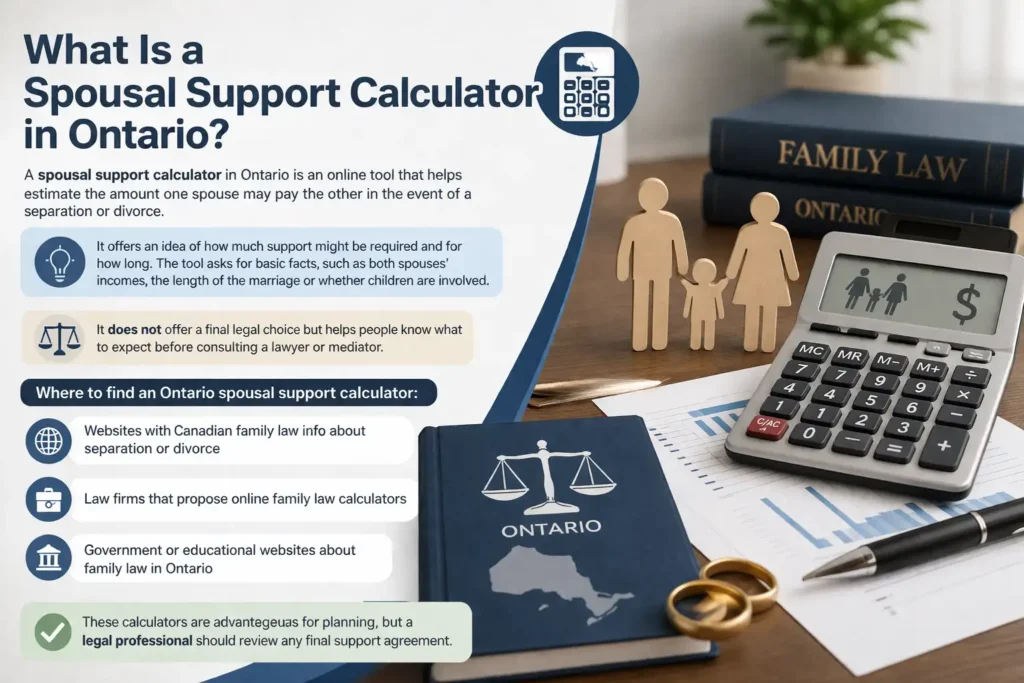
What Is a Spousal Support Calculator in Ontario?
A spousal support calculator in Ontario is an online tool that helps estimate the amount one spouse may pay the other in the event of a separation or divorce. It offers an idea of how much support might be required and for how long. The tool asks for basic facts, such as both spouses’ incomes, the length of the marriage or whether children are involved. It does not offer a final legal choice but helps people know what to expect before consulting a lawyer or mediator.
Where to find an Ontario spousal support calculator:
- Websites with Canadian family law info about separation or divorce
- Law firms that propose online family law calculators
- Government or educational websites about family law in Ontario
These calculators are advantageous for planning, but a legal professional should review any final support agreement.
Factors that Affect Spousal Support in Ontario
In Ontario, the court considers changed circumstances to determine fair spousal support. Online calculators can offer an estimate but they can’t consider each personal situation. These are the key things that disturb how much support is given and for how long:
1: Income Difference Between Spouses
- How much each spouse earns is essential.
- If one spouse earns much more than the other, they may want to pay support.
Example: One spouse earns $90,000 a year and the other earns $35,000. The higher earner may have to pay money to balance things out.
2: Length of the Relationship
How long the couple was together matters. For those who arrived in Canada through spousal sponsorship, the duration of the relationship as recognized by immigration authorities often serves as a key baseline for these calculations.
Short relationships (less than 5 years): Typically short-term or small support
Medium (5–20 years): Support for a moderate time
Long relationships (20+ years): Support could last a long time or even be unlimited
3: Financial and Non-Financial Contributions
- Support is centered on more than just money.
- Raising children and taking care of the home
- Assisting the other spouse with their work or career
- Giving up personal career chances for the family
4: Impact of Children
- Having kids also disturbs support.
- If one parent mainly takes care of the children
- Childcare prices
- Less ability to work due to parenting
5: Age, Health, and Work Ability
- Other personal factors also matter.
- Age and health of every spouse
- Education, work experience or want to retrain
- Ability to go back to work
Ontario courts use all these points to create a fair support system for equal spouses.
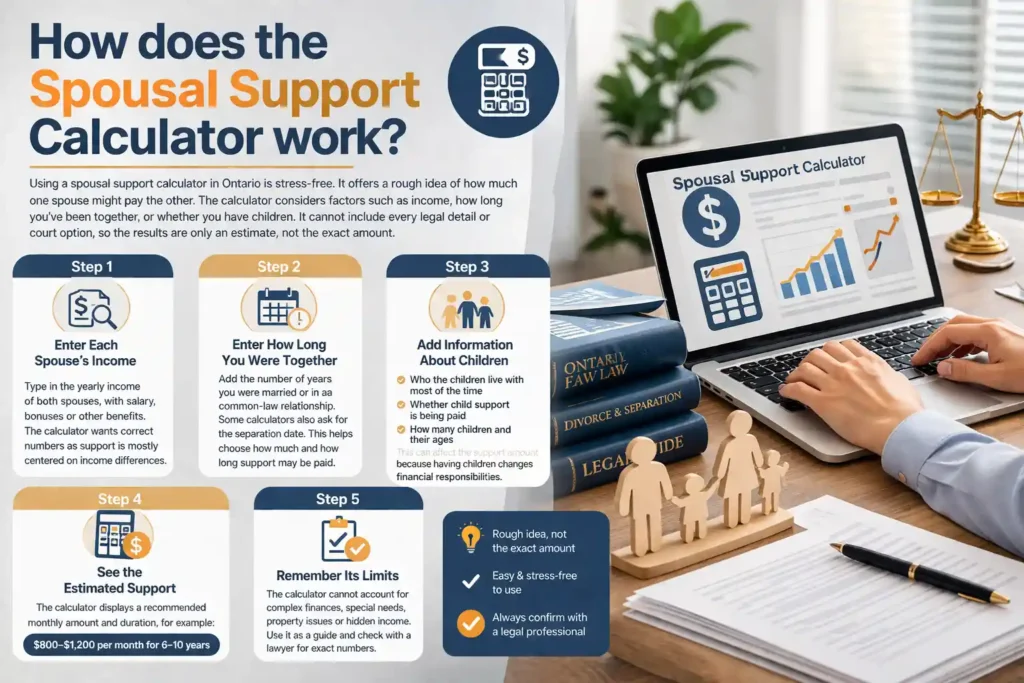
How does the Spousal Support Calculator work?
Using a spousal support calculator in Ontario is stress-free. It offers a rough idea of how much one spouse might pay the other. The calculator considers factors such as income, how long you’ve been together or whether you have children. It cannot include every legal detail or court option so the results are only an estimate, not the exact amount.
Step 1: Enter Each Spouse’s Income
Type in the yearly income of both spouses, with salary, bonuses or other benefits. The calculator wants correct numbers as support is mostly centered on income differences.
Step 2: Enter How Long You Were Together
Add the number of years you were married or in a common-law relationship. Some calculators also ask for the separation date. This helps choose how much and how long support may be paid.
Step 3: Add Information About Children
- Who the children live with most of the time
- Whether child support is being paid
- How many children and their ages
This can affect the support amount because having children changes financial responsibilities.
Step 4: See the Estimated Support
The calculator displays a recommended monthly amount and duration, for example: $800–$1,200 per month for 6–10 years.
Step 5: Remember Its Limits
The calculator cannot account for complex finances, special needs, property issues or hidden income. Use it as a guide and check with a lawyer for exact numbers.
Example of Spousal Support Calculation in Ontario
To get how the calculator works, let’s look at a usual example in Ontario.
Example 1: Couple Without Children
A couple was married for 12 years. One person earns $85,000 a year or the other earns $40,000. To see how these numbers reflect a real-life example of judicial decision-making in Ontario A spousal support calculator can offer an idea of how much money might be paid. It’s just a rough estimate and not a legal choice.
Monthly support: about $700–$1,000
Duration: 6–12 years
This estimate is based on income differences and the length of their marriage.
Example 2: Couple with Children
This couple has two children. One parent takes care of the kids most of the time, so they may not be able to work full-time. The spousal support calculator considers this or provides an estimate of the monthly amount that might be paid. Recall that it is only an estimate and not a final legal decision.
- Spouse A earns $100,000 a year
- Spouse B earns $30,000 a year
- Spouse B takes care of the children
- Monthly support: $1,200–$1,800
Support may last longer because of childcare.
These examples show that different Ontario spousal support factors can significantly change the estimated effects.
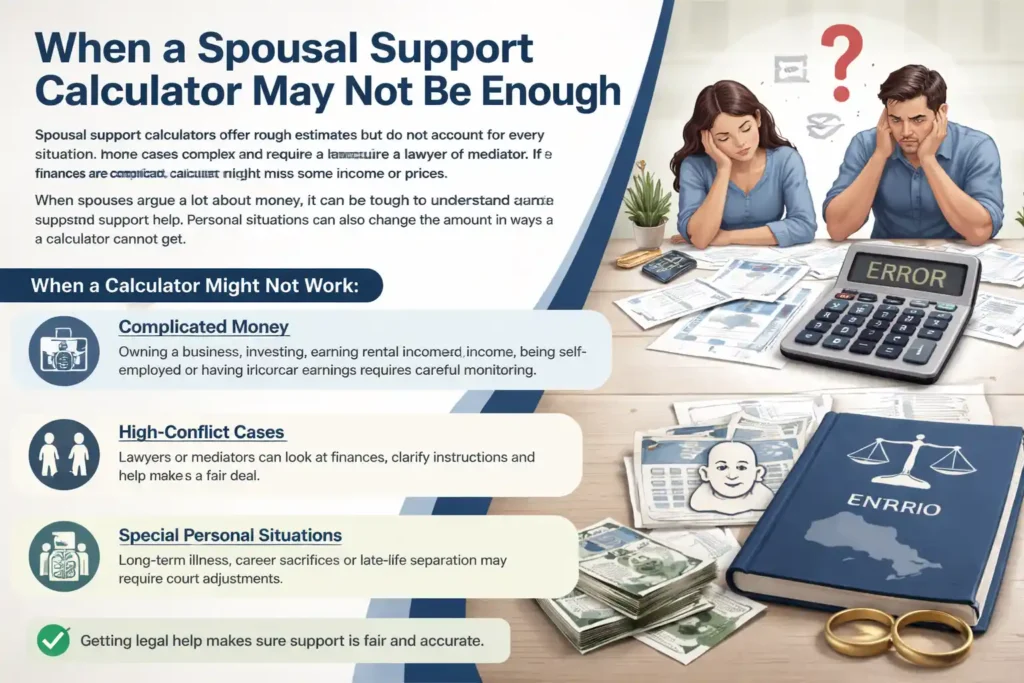
When a Spousal Support Calculator May Not Be Enough
Spousal support calculators offer rough estimates but do not account for every situation. Some cases are more complex and require a lawyer or mediator. If finances are complicated, a calculator might miss some income or prices. When spouses argue a lot about money, it can be tough to understand support without help. Personal situations can also change the amount in ways a calculator cannot get.
When a Calculator Might Not Work:
Complicated Money: Owning a business, investing, earning rental income, being self-employed or having irregular earnings requires careful monitoring.
High-Conflict Cases: Lawyers or mediators can look at finances, clarify instructions and help make a fair deal.
Special Personal Situations: Long-term illness, career sacrifices or late-life separation may require court adjustments.
Getting legal help makes sure support is fair and accurate.
Final Thoughts
To conclude that knowing to how to calculate spousal support in Ontario is really essential if you are going through a separation or divorce. A spousal support calculator can offer a rough idea of payments but it cannot cover all. Things like additional expenses or hidden income and what a court may choose are not included in the calculator. Each couple’s situation is changed and support depends on income, how long you have been married o childcare responsibilities. A calculator is a good starting point to help you plan and talk about money. But getting assistance from a family lawyer or mediator is key to ensuring everything is fair. Using to both the calculator and professional advice offers you a clearer picture and less anxiety. For those navigating the complexities of an ongoing application, our guide on the Spousal Sponsorship Interview explains the level of scrutiny involved in verifying genuine relationships.