
Updated on April 14, 2026 by canadian immigration experts
Canada is famous for its good healthcare and welcoming immigration policies. Over the past 9 years, the Express Entry system has become an essential way for skilled workers, particularly healthcare professionals, to immigrate to Canada. There is a growing demand for doctors, nurses, pharmacists, and other healthcare workers, offering various opportunities to work in Canada and obtain permanent residency.
This guide shows how Canadian immigration healthcare professionals can take advantage of the latest updates, such as special draws and priority programs. By learning these instructions and following simple steps, healthcare workers can switch the immigration procedure more easily, improve their chances of success, and make their move to Canada smoother and quicker.
The Current Landscape of Canadian Immigration
1: Express Entry Evolution
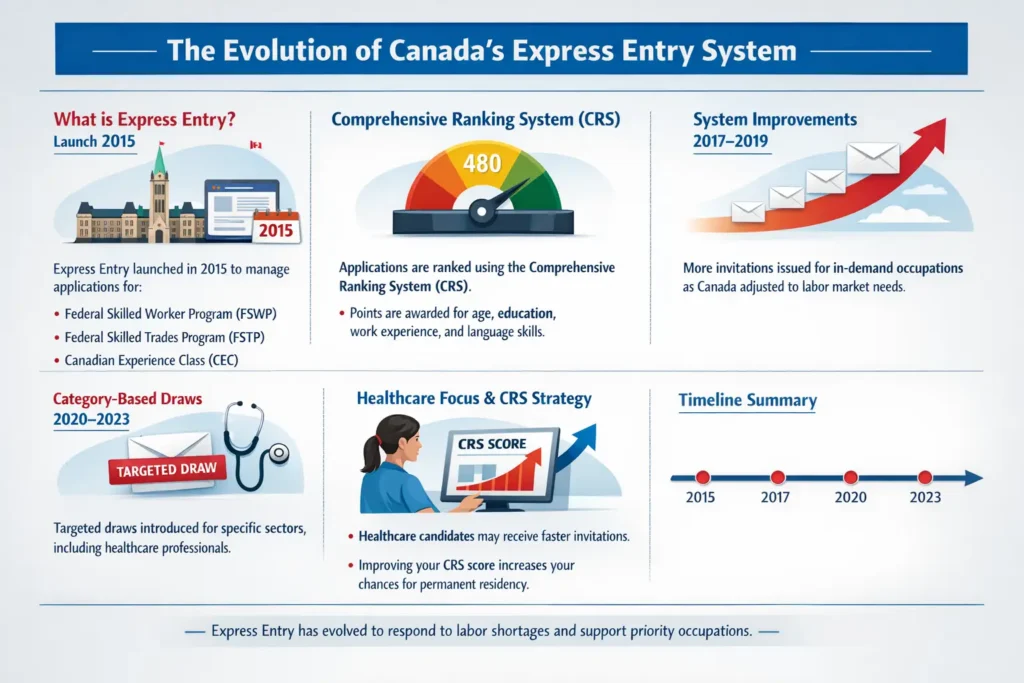
The Express Entry system started in 2015 to handle applications for three key programs: the Federal Skilled Worker Program (FSWP), the Federal Skilled Trades Program (FSTP) and the Canadian Experience Class (CEC). It has improved over time, enabling applications sooner and focusing on the jobs Canada needs. The system uses the Comprehensive Ranking System (CRS) to offer points for age, education, work involvement and language skills.
For healthcare staff, Express Entry healthcare draws are key, as people with strong healthcare experience may receive invitations more quickly. Checking your CRS score healthcare Canada helps you improve your chances and take steps to recover your score for permanent residency.
Important milestones in the Express Entry system history:
2015: Express Entry system launched.
2017–2019: More invitations sent for in-demand jobs.
2020–2023: Draws for particular jobs, like healthcare, started.
Over 1.5 million invitations have been specified, with many going to healthcare workers. These changes show Canada needs skilled workers in the jobs it wants most.
2: Increasing Difficulty for General Applicants
Express Entry makes it stress-free to move to Canada, but with more people applying, it’s getting tougher to get invited.
From 2017 to 2023, CRS scores for general applicants went up:
2017: Around 430–450 points.
2023: Often over 470 points.
If you don’t have a Canadian education or work involvement, it can be tougher to reach these points. Improving skills and getting more qualifications can help.
Healthcare workers benefit, as some draws require fewer points for their jobs.
Tip: Check CRS trends and plan carefully to increase your chances of success.
The Healthcare Advantage: Category-Based Selection
Targeted Draws:
Canada runs special invitation rounds for certain jobs where there are gaps. Healthcare jobs are the best priority. These draws center on nurses, doctors, dentists, pharmacists, and other healthcare workers. Other areas, such as STEM, transport, and skilled trades, also receive significant attention in 2026.
These specialized rounds are a game-changer for medical professionals. Since Canada prioritizes filling labor gaps in the medical sector, the requirements for nurse immigration to Canada and other healthcare roles are often more flexible than general draws. Under the updated 2026 rules, candidates must now have at least 12 months of experience in their specific healthcare role to qualify for these draws. This means that even if the overall CRS cutoff for general applicants is high (often exceeding 500), nurses and doctors meeting the 12-month requirement can receive an Invitation to Apply (ITA) with a much lower score. Securing professional representation can help you navigate these category-based draws to ensure your profile is optimized for the highest possible ranking.
Benefits of Targeted Draws:
- Invitations are given even if general CRS scores are high.
- Applicants with relevant work experience have better probabilities.
- Some draws are processed sooner as healthcare wants are urgent.
- Helps fill key gaps in Canada’s healthcare system.
Lower CRS Scores for Healthcare Professionals:
Healthcare draws typically want lower CRS scores than general draws. For example:
Federal healthcare draw: CRS 422
Ontario healthcare draw: CRS 379
Lower CRS scores make it stress-free for qualified healthcare workers to get an invitation. This offers skilled professionals a better chance to move to Canada and receive support with urgent healthcare needs. For instance, recent provincial trends show a high volume of invitations for those with specific experience; you can see a prime example of this in the Express Entry Ontario Immigrant Nominee Program invites 511 candidates update. These targeted draws prove that provinces like Ontario are actively seeking healthcare professionals even when general federal scores remain high.
Eligibility and Qualifications
1: In-Demand Healthcare Occupations
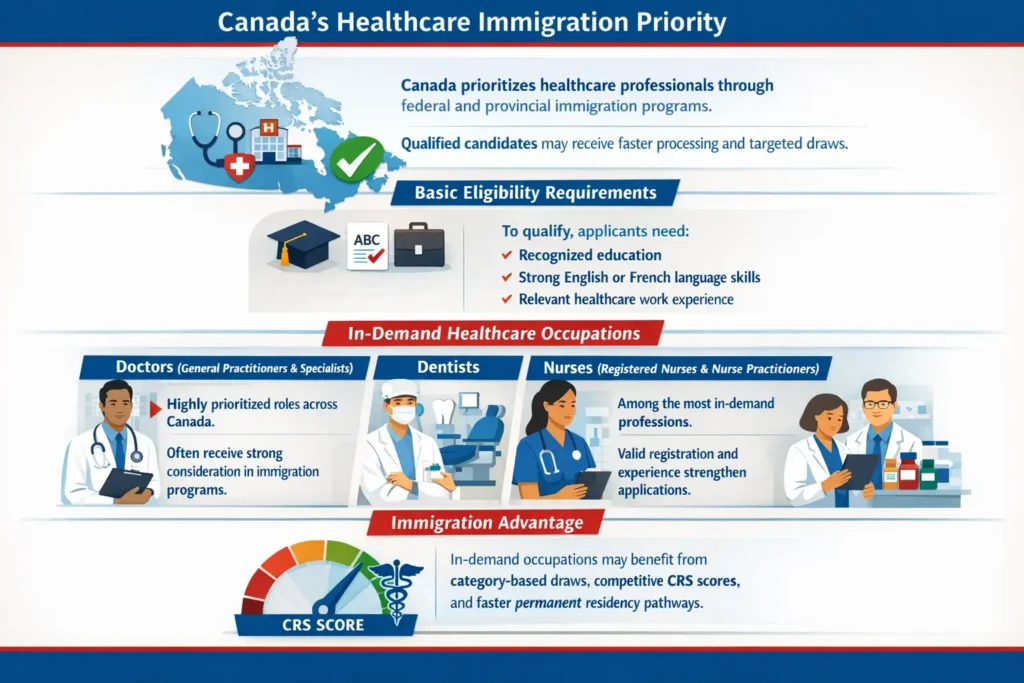
Canada prioritizes healthcare workers through federal and provincial immigration programs. Some healthcare jobs are “in-demand,” which makes it stress-free for qualified people to apply for permanent residence. To be eligible, you need the right education, strong language skills and work experience. People in these jobs may get distinct draws, lower CRS points, and faster PR processing. Knowing the job requirements helps you prepare a strong application.
Canada has a list of healthcare jobs that are in high demand:
Doctors (general practitioners & specialists) – These roles are very key and applicants frequently get priority in immigration programs.
Dentists – required in some provinces. Having the correct licenses and credentials aids your chances.
Nurses (Registered Nurses, Nurse Practitioners) – Nurses are in high demand and displaying valid involvement and registration makes applications stronger.
Pharmacists & Medical Lab Technologists/Technicians – These specialized jobs are very sought after for their skills in medicine and diagnostics.
2: Language Requirements
Good language skills are key to working in Canada’s healthcare system. English is tested with IELTS, and French with TEF Canada. Higher-level jobs may want higher scores, while bachelor-level jobs want moderate scores. Strong language effects help your CRS points and show you can talk well at work.
3: Work Experience
You should have at least three years of healthcare experience. Work done outside Canada counts, but you want proof. Particular roles, like surgeons or pharmacists, may want extra documents for training and certifications. Having experience along with education and language skills increases your chances for directed healthcare immigration draws and getting an invitation to apply for PR.
Key Strategy: The “PR First” Approach
The “PR First” method is a new and stress-free way for healthcare workers to move to Canada. Previously, you had to get a Canadian license before you could immigrate. Now, you can get permanent residency (PR) first. This means you can live and work in Canada immediately and prepare for your professional exams later. It helps lots of international healthcare workers who find early licensing also hard.
No Canadian License Needed Before PR
With this methodology, you do not want a Canadian license to apply for PR. You can apply, move to Canada as a permanent resident, and then focus on your licensing exams. This eliminates the pressure of passing hard exams while still in your home country. Nurses, doctors and other healthcare experts can start their Canadian life first and plan their careers once they settle.
The Process
Language and Credential Check – First, complete a language test like IELTS or TEF and get an Educational Credential Assessment (ECA). This shows your education is valid in Canada. It also helps your Express Entry points, which is key for healthcare draws. Doing this in a timely manner saves time and makes your PR application stress-free.
Express Entry Profile – Create your Express Entry profile and enter the pool for healthcare draws. Immigration officers consider your involvement, credentials, and language skills. You don’t want a license yet. A strong profile increases your chances of getting an Invitation to Apply (ITA).
Invitation to Apply (ITA) – If your profile ranks high, you get an ITA. This is the official invitation to apply for PR. Collect your documents, such as experience letters, ID and police checks. The ITA offers a clear start to your PR procedure.
Move to Canada – Later approval, move to Canada as a permanent resident. You can live and work anywhere. Being in Canada helps you adjust to life, know the healthcare system and plan your licensing exams. You can also gain Canadian work experience, which helps later.
Professional Licensing – When in Canada, center on passing your licensing exams. Being in Canada makes it easier to join prep courses, discover mentors, and get practical involvement. You can practice your profession while having the security of PR. The “PR First” method makes the path smoother and less worrying.
Actionable Steps for Applicants
Immigrating to Canada can feel unclear, but following clear steps makes it easier. Each step you finish recovers your chances and makes your application stronger. Keep on organizing and planning onward; it helps a lot.
Step 1: Language Exam
A good language score is very key to your points and for immigration.
Tests: IELTS (English) or TEF Canada (French)
Tips:
- Register timely at approved centers.
- Use official study resources and practice tests.
- Try to get the maximum score you can to get more points.
Step 2: Educational Credential Assessment (ECA)
An ECA checks if your foreign degree is equal to a Canadian degree.
- Required if you don’t have a Canadian education.
- Familiar organizations recognized by the government include WES Canada, ICAS, and IQAS.
- You must have a legal ECA previously entering the Express Entry pool.
Step 3: Enter the Express Entry Pool
When finishing your language test and ECA:
- Create a profile in the Express Entry system.
- Select your job properly to qualify for healthcare draws.
- Watch draws and CRS scores to plan your next steps.
Entering the pool on time and being prepared helps you get an invitation quicker particularly for healthcare jobs. Have a track of deadlines, recover your CRS score and stay on track to make the procedure easier.
Conclusion
To conclude that moving to Canada as a healthcare worker requires careful planning and fast action. Programs like Express Entry and special healthcare draws offer doctors, nurses, pharmacists and other medical workers a good chance to get long-lasting residency. Canada immigration for doctors, nurse immigration Canada and other healthcare paths have lower points required and quicker invitations, so it’s essential to start in a timely manner. Doing language tests, getting an EC and entering the Express Entry pool are the first key steps. Canada wants expert healthcare workers, so acting now offers you an advantage. By preparing well and following the steps, you can start a successful healthcare career and secure permanent residency in Canada.
If you are a healthcare worker and need to move to Canada, check official sources like IRCC or talk to a licensed immigration consultant. The faster you get ready, the quicker you can apply for special healthcare programs and start living in Canada as a permanent resident.