
Updated on April 14, 2026 by canadian immigration experts
Immigration, Refugees and Citizenship Canada (IRCC) has introduced significant updates to the rules governing LMIA-exempt work permits issued through reciprocal employment agreements, changes that could substantially impact both Canadian employers and foreign workers seeking opportunities in Canada.
Published on February 20, 2026, these revised guidelines under the International Mobility Program provide greater clarity around eligibility requirements, processing procedures, and documentation standards for work permits issued without requiring a Labour Market Impact Assessment (LMIA). Our team at Jane Katkova & Associates understands our clients’ options for those who currently have a Canadian work permit. Having a deep knowledge of these nuanced policy changes is essential for ensuring successful applications.
Understanding LMIA-Exempt Work Permits Through Reciprocal Employment
The reciprocal employment category represents one of several pathways through which foreign nationals can obtain Canadian work permits without the typically mandatory LMIA, a process that requires employers to demonstrate that no qualified Canadian citizens or permanent residents are available to fill the position.
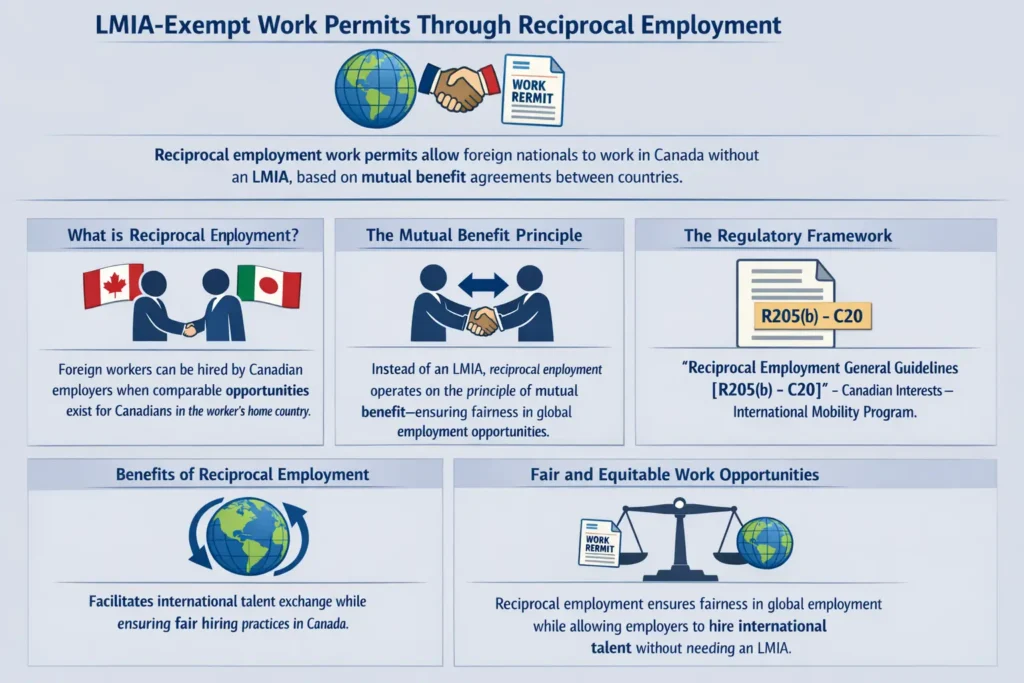
Instead of going through the Labour Market Impact Assessment process, reciprocal employment work permits operate on the principle of mutual benefit: Canadian employers can hire foreign workers when comparable opportunities exist for Canadians or permanent residents in the worker’s home country. This framework facilitates international talent exchange while ensuring fairness in global employment opportunities.
The updated instructions fall under the regulatory provision R205(b)“Reciprocal employment general guidelines [R205(b) – C20] – Canadian interests – International Mobility Program,” replacing the previous framework titled “International Mobility Program (IMP): Canadian interests – Reciprocal employment general guidelines R205(b), C20.”
Key Changes in the Revised IRCC Guidelines
Clarified Reciprocity Requirements for Canadian Workers
One of the most significant updates involves how immigration officers assess whether genuine reciprocity exists between Canada and the foreign worker’s country of origin. The revised guidelines explicitly state that officers must consider employment opportunities available to “Canadian citizens or permanent residents of Canada,” specifically “in the country where the worker is coming from.”
This language represents a meaningful departure from previous instructions, which used the more ambiguous phrasing “when Canadians have similar reciprocal opportunities abroad.” The new wording provides three critical clarifications:
First, reciprocity now explicitly extends to Canadian permanent residents, not exclusively citizens, recognizing that permanent residents constitute an integral part of Canada’s workforce and should benefit equally from international employment agreements.
Second, the reciprocity must exist specifically in the country from which the individual foreign worker originates, rather than simply existing somewhere internationally. This prevents situations where general international agreements might be applied inappropriately to countries that don’t actually offer comparable opportunities for Canadians.
Third, officers now have clearer guidance on evaluating whether legitimate reciprocal arrangements exist, reducing discretionary interpretations that previously led to inconsistencies in application processing.
Recognition of Maintaining Existing Reciprocal Positions
The updated guidelines introduce important language not just about creating new reciprocal employment opportunities but also about maintaining existing ones. Officers are now instructed to consider whether the applicant’s job offer serves to “create or maintain reciprocal employment” abroad.
This clarification proves particularly valuable for established organizations with longstanding international exchange relationships. Previously, there was some uncertainty about whether maintaining existing positions for Canadians abroad would sufficiently demonstrate reciprocity for new work permit applications. The revised language removes this ambiguity, recognizing that sustaining ongoing reciprocal opportunities holds equal value to establishing new ones.
For Canadian employers seeking to hire foreign talent under reciprocal employment provisions, this change simplifies the process of demonstrating eligibility, particularly for organizations that have maintained consistent international employment opportunities over extended periods.
Organizational History and Permit Volume Considerations
The updated guidelines maintain provisions around how immigration officers should evaluate organizations based on their history of reciprocal employment arrangements:
For newer organizations with limited reciprocity history, officers are encouraged to initially issue fewer work permits while assessing whether genuine reciprocal opportunities exist and are being maintained.
For established organizations demonstrating several years of consistent reciprocity, officers have greater flexibility in approving larger numbers of work permits and can assess reciprocity over extended periods, potentially spanning five years, rather than requiring annual demonstration.
This tiered approach rewards organizations that have proven their commitment to genuine reciprocal employment while maintaining appropriate scrutiny for newcomers to these immigration programs.
Cultural Exchange Agreements and Program Exclusions
The revised guidelines apply to work permits issued under cultural agreements with Belgium, Brazil, Germany, Italy, Japan, Mexico, France, and China, facilitating talent exchange across diverse sectors, including arts, education, research, and cultural industries.
However, these instructions specifically do not apply to work permits issued through the International Experience Canada program, which operates under separate rules designed for youth mobility rather than professional reciprocal employment.
What These Changes Mean for Canadian Employers
Canadian employers, including educational institutions, cultural organizations, and private-sector companies, can continue to bring in foreign workers under reciprocal employment provisions, provided they demonstrate that genuine reciprocal opportunities exist for Canadian citizens and permanent residents.
Importantly, formal bilateral agreements between governments are not required for these work permits. Instead, employers must show that their hiring practices help maintain or create employment opportunities for Canadians abroad, whether through direct international operations, partnerships, or exchange programs.
The revised guidelines make clear that in cases where reciprocity cannot be adequately demonstrated, or applications are refused, employers retain the option to obtain a Labour Market Impact Assessment and proceed through the Temporary Foreign Worker Program instead.
Why Professional Immigration Guidance Matters More Than Ever
These policy updates, while explaining aspects of reciprocal employment work permits, also introduce additional complexity around documentation standards, reciprocity assessment, and administrative requirements. For foreign workers seeking Canadian employment and employers navigating hiring processes, the services our specialists provide produce significant advantages:
Accurate eligibility assessment, ensuring applications proceed under the most appropriate immigration pathway
Comprehensive documentation preparation that meets revised GCMS requirements and prevents processing delays
Strategic positioning of applications based on organizational history and reciprocity evidence
Proactive problem-solving when complications arise or additional information is requested
As Canadian immigration policies continue evolving, staying current with regulatory changes and understanding their practical implications separates successful applications from costly refusals and delays.
Moving Forward: Strategic Considerations for LMIA-Exempt Work Permits
Whether you’re a Canadian employer seeking to hire international talent, a foreign worker exploring opportunities in Canada, or an immigration professional advising clients on work permit options, our team at Jane Katkova & Associates provides a comprehensive handling of your work permit application. With over 25 years of experience, we have adapted to understanding these revised guidelines, ensuring compliance with current requirements and maximizing the likelihood of approval. Reach out now to begin your 2026 LMIA-Exempt work permit application!