
Updated on September 23, 2026 by canadian immigration experts
Realizing you might be the subject of a police inquiry is stressful. This guide explains the realistic signs you are under police investigation in Canada, including signs that cops are watching your house, the Charter rights that protect you, and the sensible steps to take. It also covers something many people overlook: how a criminal matter can create criminal inadmissibility for non-citizens. This is general information, not legal advice, and it is not a guide to avoiding or interfering with any lawful investigation.
What Does Being Under Police Investigation Mean in Canada?
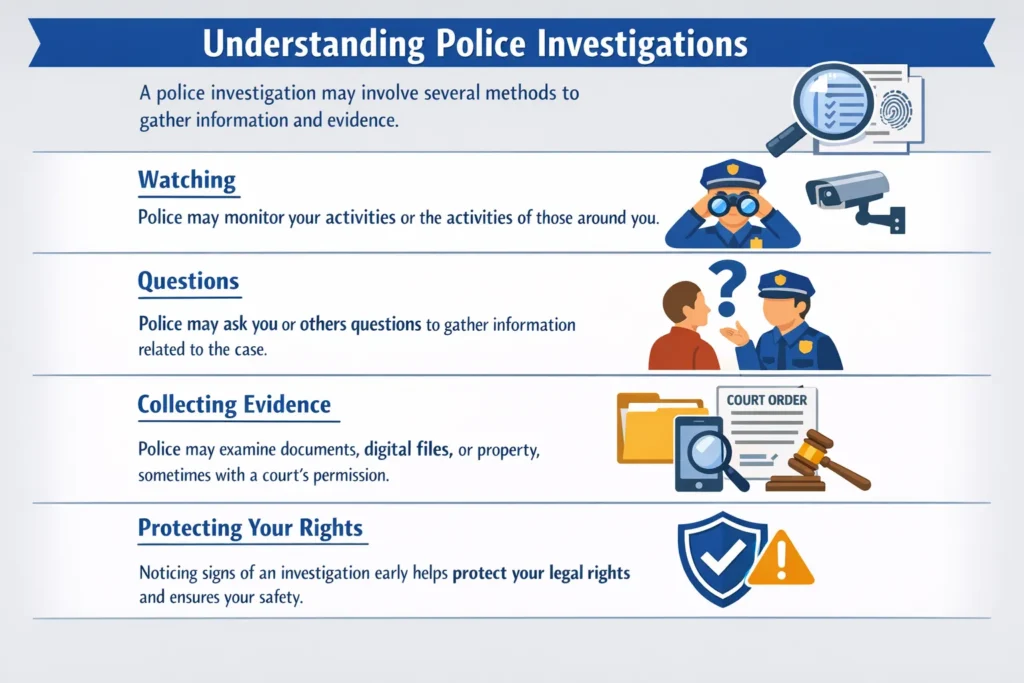
A police investigation is simply the process of gathering facts to determine whether an offence occurred and who may be connected to it. Being investigated does not imply guilt and does not guarantee that charges will ever be laid — it means authorities are examining information.
An investigation may involve:
- Interviewing witnesses and people connected to a matter;
- Collecting physical, digital, or financial evidence;
- Applying to a court for a search warrant or production order (an order requiring a bank, employer, or company to hand over records);
- Conducting surveillance in public places; and
- Reviewing documents and electronic records.
Signs You May Be Under Police Investigation
No single sign is proof of anything, and some have innocent explanations. Taken together, however, the following are the realistic indicators people notice.
Direct contact or questioning by police
The clearest sign is police reaching out — a phone call, a request to “come in for a chat,” a visit to your home or workplace, or officers asking questions framed as routine. Even casual-sounding questions can be part of an investigation.
Police have contacted your associates
You may learn that officers have spoken to friends, family, coworkers, or business contacts about you. When people around you mention being questioned, it can indicate an active inquiry.
A search warrant or production order
Being served with a search warrant, or learning that your bank, employer, phone provider, or accountant received a production order for your records, is a strong indication that an investigation is underway.
Requests for financial or personal records
Unusual requests for documents, account information, or access to your devices — whether directed at you or at institutions that hold your data — can be part of evidence gathering.
Signs that cops are watching your house or following you
Some people notice what feels like surveillance: an unfamiliar vehicle parked nearby for long periods, the sense of being followed, or repeated contact attempts from unknown numbers. Police are permitted to observe people in public places. It is worth remembering that stress can also make ordinary events feel significant, so try not to jump to conclusions — but do take note.
Changes in how others behave toward you
Sometimes the earliest signal is indirect: people becoming guarded, cancelling plans, or hinting that they were asked about you.
What to Do If You Think You’re Under Investigation
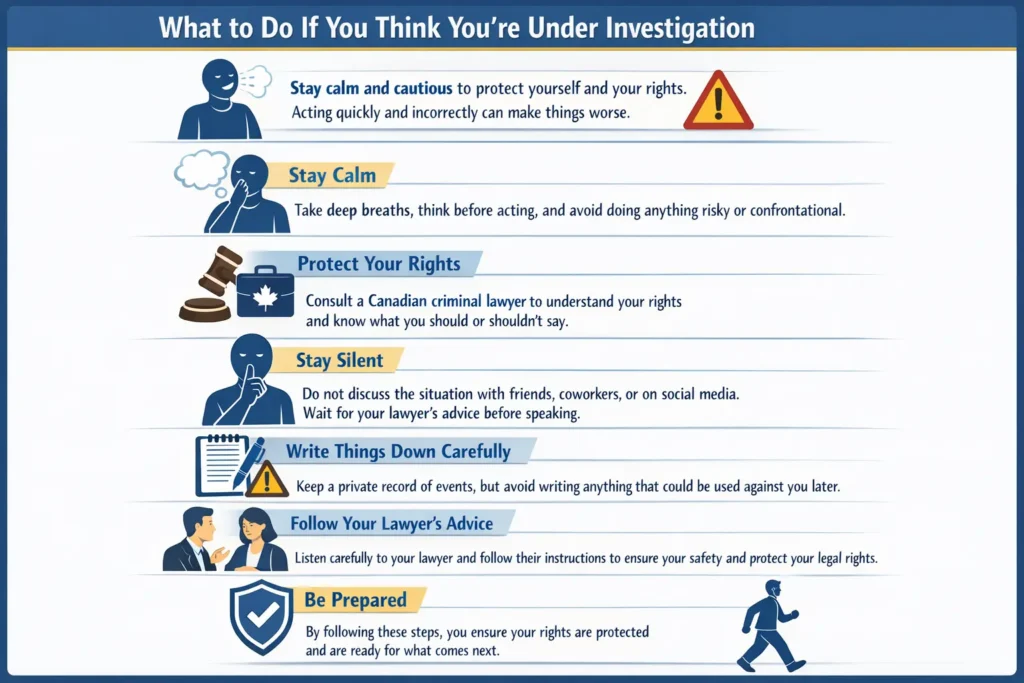
Your goal is to protect your legal rights and cooperate with the law — not to interfere with it. Never destroy evidence, contact potential witnesses about the case, or lie to police; those actions are themselves criminal offences (such as obstruction). Instead, follow these steps.
Key steps to follow
- Stay calm. An investigation is not a conviction, and panicking rarely helps.
- Exercise your right to remain silent. You are generally not required to answer questions. Politely state that you wish to speak with a lawyer first.
- Ask if you are free to leave. If you are not being detained or arrested, you may leave. If you are, you have the right to counsel.
- Do not obstruct or mislead. Do not destroy documents or devices, and do not ask others to change their account of events.
- Write down what happened. Note dates, times, officers’ names or badge numbers, and what was said, while it is fresh.
- Contact a criminal defence lawyer immediately. This is the single most important step.
Your Charter Rights During a Police Investigation
The Canadian Charter of Rights and Freedoms protects everyone in Canada, including permanent residents and foreign nationals. The rights that matter most during an investigation are:
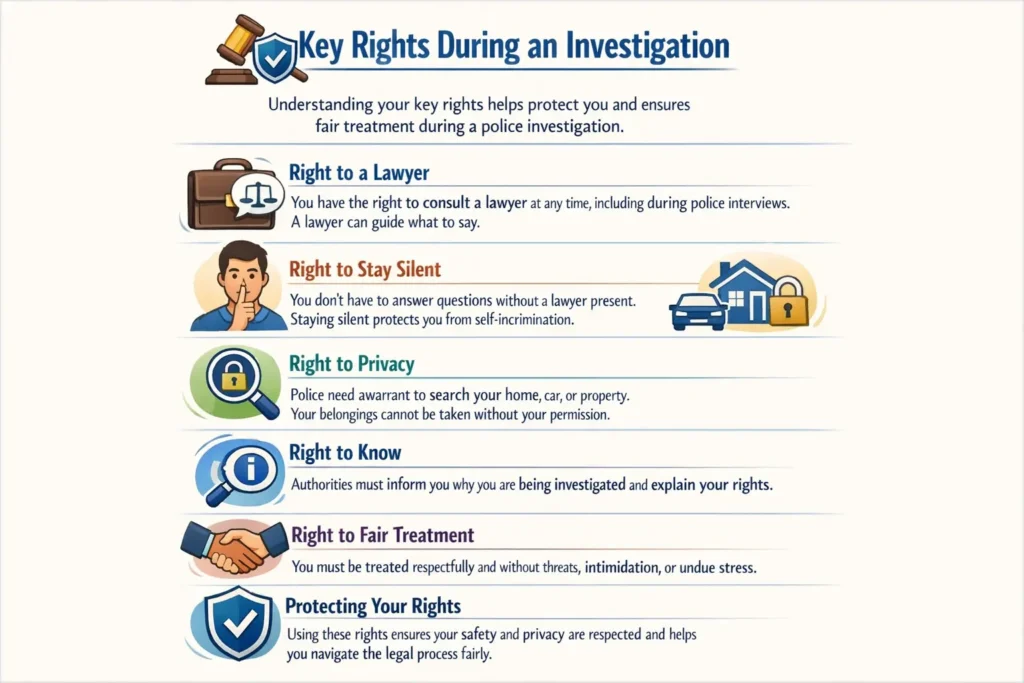
- The right to silence (Section 7). The right not to incriminate yourself is protected under section 7. You generally do not have to answer police questions, and your silence cannot be used as evidence of guilt.
- The right to counsel (Section 10(b)). On arrest or detention, you have the right to be told why, and to retain and instruct a lawyer without delay — and to be informed of that right. You can also access free duty counsel.
- Protection against unreasonable search and seizure (Section 8). Police generally need a warrant or lawful authority to search your home, devices, or records.
- The right to know the reason for detention (Section 10(a)) and to have the lawfulness of your detention reviewed.
These protections exist precisely so that people can respond to police lawfully and with proper advice. Using them is not evidence of wrongdoing.
When Should You Contact a Lawyer?
Sooner is better than later. The best time to speak to a criminal defence lawyer is before you answer any questions or attend any interview — not after. A lawyer can explain your obligations, communicate with police on your behalf, and help ensure you do not accidentally harm your own position. If you are ever arrested or detained, ask to call a lawyer immediately and say nothing further until you have.
The Immigration Angle: Criminal Charges and Inadmissibility to Canada
For Canadian citizens, a criminal matter is a criminal matter. For permanent residents and foreign nationals, there is a second, serious layer: a charge or conviction can create criminal inadmissibility, which may threaten your status, a pending application, or your ability to enter or remain in Canada. This is why immigration status should be part of the conversation from day one.
How criminal inadmissibility works
Under section 36 of the Immigration and Refugee Protection Act (IRPA), inadmissibility is divided into two broad categories:
- Serious criminality — applies to both permanent residents and foreign nationals, generally for an offence in Canada punishable by a maximum of 10 years or more, or where a sentence of more than six months was imposed.
- Criminality — applies to foreign nationals for offences that would be indictable in Canada, including certain offences committed outside Canada.
The consequences differ by status. A permanent resident found inadmissible for serious criminality can face a removal order; a foreign national may be refused a visa, denied entry, or removed. Because these outcomes can follow a conviction — sometimes years later — early coordination between your criminal lawyer and an immigration professional is essential.
Options if you are criminally inadmissible
There are established legal ways to address criminal inadmissibility. The right option depends on the offence, the sentence, and how much time has passed:
| Option | What it does | Best for |
|---|---|---|
| Temporary Resident Permit (TRP) | Grants temporary entry or stay despite an active inadmissibility, for a defined purpose and period. | Those who need to enter or remain in Canada before enough time has passed for a permanent solution. |
| Criminal Rehabilitation | Permanently resolves the inadmissibility for the offences covered, once eligibility criteria are met. | People whose sentence was completed at least five years ago. |
| Deemed rehabilitation | Inadmissibility may lapse automatically with the passage of enough time for certain less serious offences. | Older, single, less serious offences meeting IRPA criteria. |
| Record suspension (pardon) | A Canadian record suspension can remove a domestic conviction from consideration. | Convictions within Canada that are now eligible for a suspension. |
To understand which of these could apply to your situation, see our detailed guide to criminal inadmissibility to Canada, rehabilitation, and TRPs. If your matter touches Express Entry or citizenship, our resources on police certificates and Express Entry completeness checks and Canadian citizenship are also useful.
Need help with your application? Jane Katkova & Associates, led by Jane Katkova, RCIC #R412959, has helped clients immigrate to Canada since 1995.
Frequently Asked Questions
Does being under investigation mean I will be charged?
No. An investigation means police are gathering facts to decide whether an offence occurred and who may be involved. Many investigations end without any charges. It does not imply guilt.
What are common signs that cops are watching your house?
People sometimes notice an unfamiliar vehicle parked nearby for long periods, a sense of being followed in public, or repeated contact attempts from unknown numbers. Police may observe people in public places, but stress can also make ordinary events feel significant, so avoid jumping to conclusions and take note calmly.
Do I have to answer police questions in Canada?
Generally no. You have the right to remain silent under section 7 of the Charter, and on arrest or detention you have the right to speak with a lawyer without delay under section 10(b). You should still identify yourself where legally required and must never lie to or obstruct police.
Can a criminal charge affect my immigration status in Canada?
Yes. For permanent residents and foreign nationals, a charge or conviction can lead to criminal inadmissibility under section 36 of the IRPA, which may affect a pending application or your ability to enter or remain in Canada. Anyone who is not a citizen should get immigration advice early.
What should I do first if I think I am being investigated?
Stay calm, do not answer detailed questions, do not destroy anything or contact potential witnesses, and speak to a criminal defence lawyer as soon as possible. If you are not a citizen, also consult an immigration professional.
How can I overcome criminal inadmissibility to Canada?
Depending on the offence and time elapsed, options include a Temporary Resident Permit, criminal rehabilitation, deemed rehabilitation, or a Canadian record suspension. A licensed professional can advise which one fits your circumstances.
How Jane Katkova & Associates Can Help
If a criminal matter is affecting your immigration status or a pending application, Jane Katkova & Associates can help you understand your options for TRPs, rehabilitation, and inadmissibility. Book a consultation or call +1 416-661-4487. For the criminal case itself, retain a licensed criminal defence lawyer.
This article is general information, not legal advice. It is not a guide to avoiding or interfering with any investigation. Immigration and criminal laws change frequently; confirm current requirements with the relevant authority or a licensed professional.