
Updated on February 20, 2026 by canadian immigration experts
Canada wants more nurses, and this need is expected to continue growing until 2033. More older people, rising long-term illnesses, and many nurses retiring are putting pressure on hospitals, clinics, and care homes. This is the best opportunity for internationally educated nurses to advance their careers in a country recognized for high-quality patient care and job opportunities. To work in Canada, it’s key to know the nursing licensing process. This ensures all nurses meet Canadian standards and can work securely. Canada is attractive for internationally educated nurses as Registered Nurses are in the Tier 1 category, which offers an easier path to Permanent Residence (PR).
This guide will help making it simple to begin a nursing career in Canada. To begin, it’s important to understand the different nursing categories in Canada.
Understanding Nursing Categories in Canada
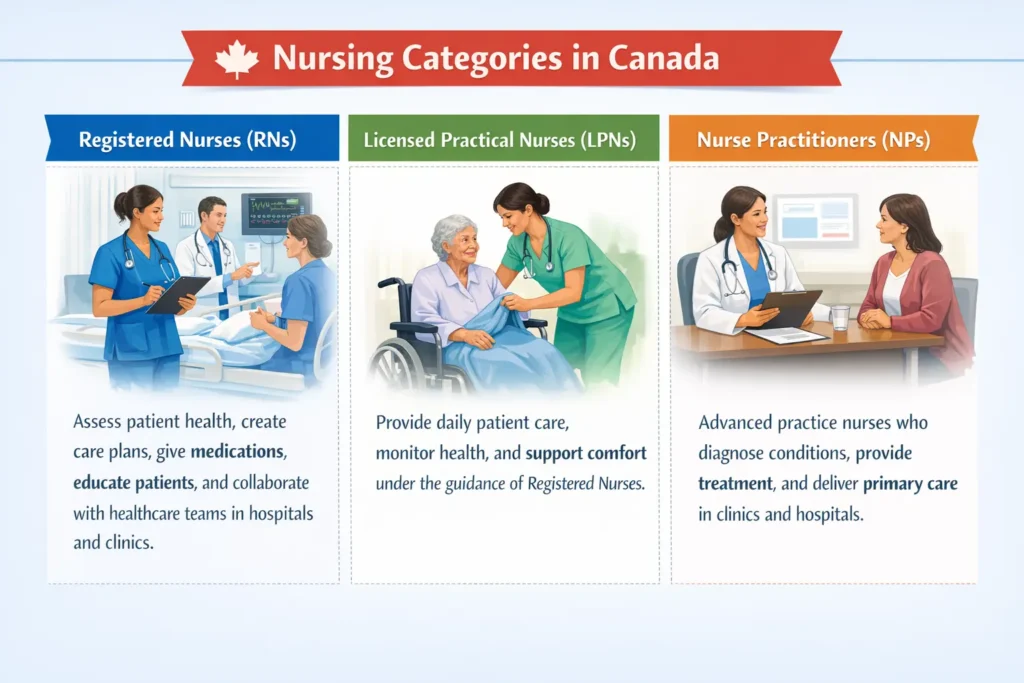
If you need to work as a nurse in Canada, then it is key to know the different kinds of nurses and what they do. Each type has diverse duties, training and responsibilities. Registered Nurses (RNs) are the primary group and provide patient care in various ways. Licensed Practical Nurses (LPNs) and Nurse Practitioners (NPs) also play key roles and work with RNs to help patients. Knowing to these kinds helps future nurses select the right career and understand what is expected of them.
Key Nursing Categories
Registered Nurses (RNs): RNs assess patient health, develop and implement care plans, administer medications, and educate patients and families. They collaborate with other healthcare professionals on complex cases. RNs work in hospitals, clinics and specialized settings and require advanced knowledge, critical thinking and communication skills.
Licensed Practical Nurses (LPNs): LPNs care for patients under RNs’ guidance. They do everyday care tasks, watch patients’ health and help patients feel comfortable. Their work is more limited than that of RNs but it’s very important for daily patient care.
Nurse Practitioners (NPs): NPs are highly trained nurses who can diagnose, provide treatment and deliver primary care. They want more education than RNs. NPs work in clinics, hospitals and special care areas, assisting patients and handling difficult cases.
Understanding to these nursing categories clarifies each role’s skills, duties and place in Canada’s healthcare system.
The Universal Licensing Process for Internationally Educated Nurses (IENs)
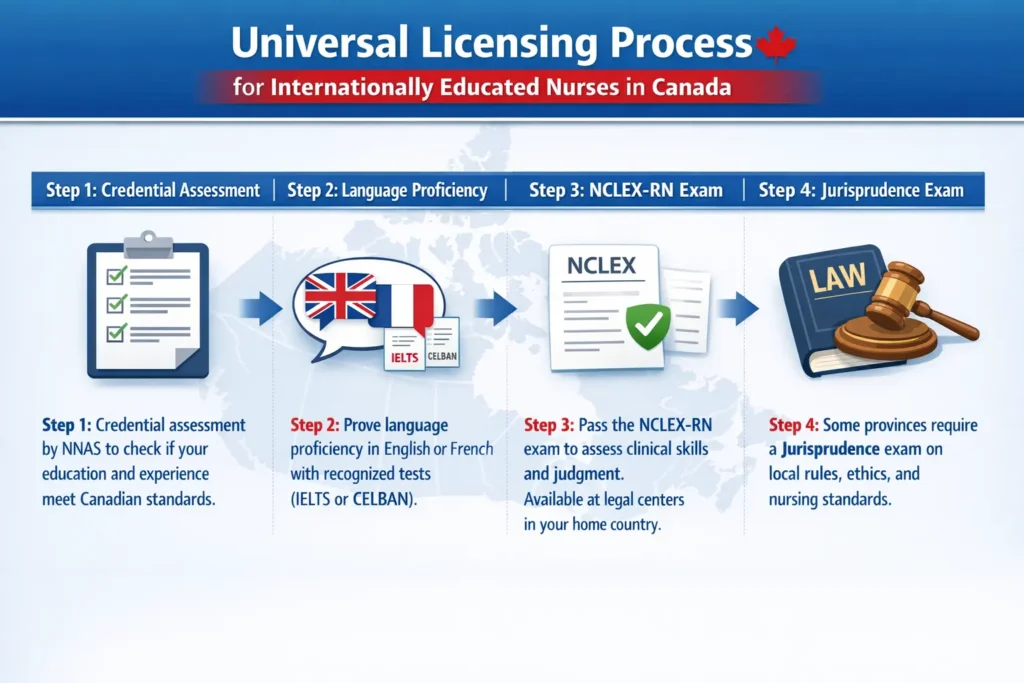
If you trained as a nurse outside Canada and need to work there, then you must follow a licensing procedure. This ensures you meet Canadian standards for security, skills and knowledge. The method is step-by-step and helps you easily navigate the Canadian healthcare system. It includes checking your education and work experience, proving language skills, passing exams and learning local laws and ethics. Finishing all steps opens the door to a nursing career in Canada and supports immigration programs.
Step-by-Step Process:
Credential Assessment: Your education and work experience are checked by the National Nursing Assessment Service (NNAS) to determine if they meet Canadian standards. Some provinces, like Ontario, also accept WES or ICAS after 2025.
English or French Proficiency: You must demonstrate that you can speak and write English or French. Tests such as IELTS or CELBAN are recognized. Good scores are required for equal licensing and immigration.
NCLEX-RN Exam: This exam tests your nursing knowledge, clinical skills and clinical judgment. You can take it at legal centers in your home country.
Jurisprudence Exam: Some provinces need an online test about local rules, ethics and nursing rules.
Following these steps will help you start your Registered Nurse PR pathway in Canada.
Ontario (CNO) Nursing Pathway – Simple Explanation
Ontario is a common option for internationally educated nurses as its licensing procedure is clear and well-organized. Many steps can be completed while living outside Canada which helps save time upon arrival. The College of Nurses of Ontario (CNO) checks that all nurses meet Canadian education and safety standards. This makes it easier for foreign-trained nurses to start working in Ontario.
Example: Nurse Jane
Nurse Jane is qualified outside Canada and is seeking a Canadian nursing license. Her experience outlines the Ontario licensing procedure step by step.
Steps Before Coming to Canada
First, Jane sends her education and work documents to NNAS for review. When she receives the assessment report, then she applies to the CNO from outside Canada.
Bridging or Refresher Courses
If the CNO identifies missing skills or education gaps, Jane must complete official bridging or refresher programs. These courses enable her to meet Ontario’s nursing standards.
Provisional License
Jane may receive a provisional license while she finishes her leftover necessities. This allows her to work as a nurse under supervision until she obtains full registration.
Provincial Variations and Highlights
Nursing rules in Canada vary from province to province. Each province has its own nursing authority, timelines and necessities. As a result, internationally educated nurses must check the provincial instructions that were previously applied. Some provinces process applications for nurses from certain countries more quickly. Others center more on work experience, English skills or severe document deadlines. Knowing these changes early helps nurses select the right province and avoid delays.
| Province/Territory | Nursing Licensing Details |
|---|---|
| British Columbia | Offers quicker licensing for nurses trained in the US, UK, Australia, and New Zealand. |
| Alberta | Requires 250 hours of nursing work in the last five years or completion of a bridging program. |
| Saskatchewan | Has strict deadlines for submitting documents; timely preparation is crucial. |
| Manitoba | Accepts eight alternative ways to demonstrate English language proficiency. |
| Nova Scotia & Newfoundland | Offer quicker processing through “Designated Countries Pathways.” |
| The Territories | Nurses must be licensed in another Canadian province before applying. |
Bridging to Immigration: How to Get a Work Permit
Once you have identified a potential vacancy, the next critical step is navigating the legal requirements for hiring. If you are applying through an employer-driven stream, you may also need to understand the role of an LMIA for Employment in Canada to secure your work permit. A Labour Market Impact Assessment (LMIA) is a document issued by the Canadian government that an employer must often obtain before hiring an international nurse.
It serves as official proof that there is a genuine need for your skills and that no local Canadian citizen or permanent resident was available to fill the position. Securing a job offer supported by a positive LMIA not only authorizes your work permit but can also provide significant ‘bonus points’ toward your Permanent Residence application, making it a powerful tool in your immigration journey.
Job Search
Start watching for nursing jobs as early as possible. Jobs are listed on government websites or hospital career pages and recruitment agencies. A job offer can help you obtain a work permit and improve your chances of obtaining permanent residence.
Unregulated Roles
While awaiting full nursing registration, then it is possible to work in roles such as a Personal Support Worker (PSW) or a Clinical Extern. These positions provide Canadian work experience, offer exposure to workplace procedures and facilitate professional networking.
Study Pathway
You can also study in a Canadian nursing program. Once you graduate, you may get a Post-Graduation Work Permit (PGWP) which lets you work full-time and supports permanent residence.
This step follows the nursing licensing process.
Permanent Residence: Registered Nurses PR Pathway
Working as a nurse in Canada offers you more than just a steady job. It provides a clear path to permanent residence for expert workers. Canada wants more nurses so Registered Nurses are given distinct priority in immigration programs. Nurses educated in other countries can use these programs to work in hospitals, clinics and care homes. Registered Nurses are considered highly skilled so they can apply through various federal and provincial immigration programs. Having Canadian nursing education or work experience makes it easier to get permanent residence. Due to this, nursing is one of the most harmless and consistent ways to live and work in Canada long-term.
Key benefits of the Registered Nurses PR pathway:
- Can apply directly under the Federal Expert Worker Program
- Get more points with Provincial Nominee Programs (PNPs)
- Lower score required in healthcare-focused Express Entry draws
- High demand for nurses in many provinces
Canadian work experience supports strengthening PR applic Overall, this pathway provides stability, security and long-term success for anyone building a nursing career in Canada through the Registered Nurses PR pathway.
Navigating these pathways can be complex, as each program has its own set of strict document requirements and deadlines. To ensure your application is handled with precision, it is highly recommended to seek professional guidance through the Nurse Immigration to Canada specialized services. Expert consultants can help you identify which specific program, whether it be a healthcare-targeted Express Entry draw or a Provincial Nominee Program, gives you the highest chance of success. By aligning your nursing credentials with the right immigration strategy, you can avoid common pitfalls and secure your future in Canada more efficiently.
Free Support Resources for Internationally Educated Nurses
Canada offers free programs to help nurses from other countries prepare to work and live in Canada. They offer guidance on licensing, finding jobs and settling in. Using these resources makes moving easier and less worrisome. Start early to save time and plan well. These programs help you know what to expect in Canadian healthcare.
PASS (Pre-Arrival Support and Services): Offers mentorship, online classes and help for nurses outside Canada. Supports with registration, job search and joining the Canadian workforce.
SOPA (Settlement Online Pre-Arrival): Provides online guidelines on housing, healthcare, community services and work life. Helps nurses get ready for life and work in Canada.
These resources are available at no cost and are designed to support your success. Use them before arriving in Canada to maximize their benefits.
Conclusion
To conclude that pursuing a nursing career in Canada is full of chances, growth and stability. The internationally trained nurses who complete credential checks, exams such as the NCLEX-RN, and provincial licensing steps are set up for success. The Registered Nurses PR pathway offers a clear and consistent way to work in Canada and ultimately obtain permanent residency. Using bridging programs and support resources like PASS and SOPA, along with early planning, makes the procedure easier and faster.
Canada offers great job prospects or specialized growth and a high quality of life for nurses who follow the steps cautiously. Internationally trained nurses can build a strong, rewarding career with focus and preparation. Canada is actually a place where nurses can grow or succeed and always settle.