
Updated on February 26, 2026 by canadian immigration experts
If you plan to apply through the Alberta Advantage Immigration Program (AAIP), you are possibly speculating how long it will take. The response is not always simple. Processing times can change for various reasons. It depends on how many people apply, the parameters for each stream, whether your documents are thorough, and how many nominations Alberta can offer that year.
Too, AAIP is only the initial step. Once you get a provincial nomination, you must still apply for long-lasting residence through IRCC. The federal procedure has its own timeline. Knowing every step helps you know what to expect and avoid wonders.
What Is the Current AAIP Processing Time?
The Alberta Advantage Immigration Program (AAIP) shares estimated processing times on its official website. These are only usual time ranges, not exact promises. To see how many applications are currently in the queue for your specific stream, you should regularly monitor the official AAIP inventory and processing dashboard. As of 2026, Alberta has implemented a high-volume processing system, but timelines still fluctuate based on whether the province has reached its monthly nomination allocation for streams like the Alberta Opportunity Stream (AOS).
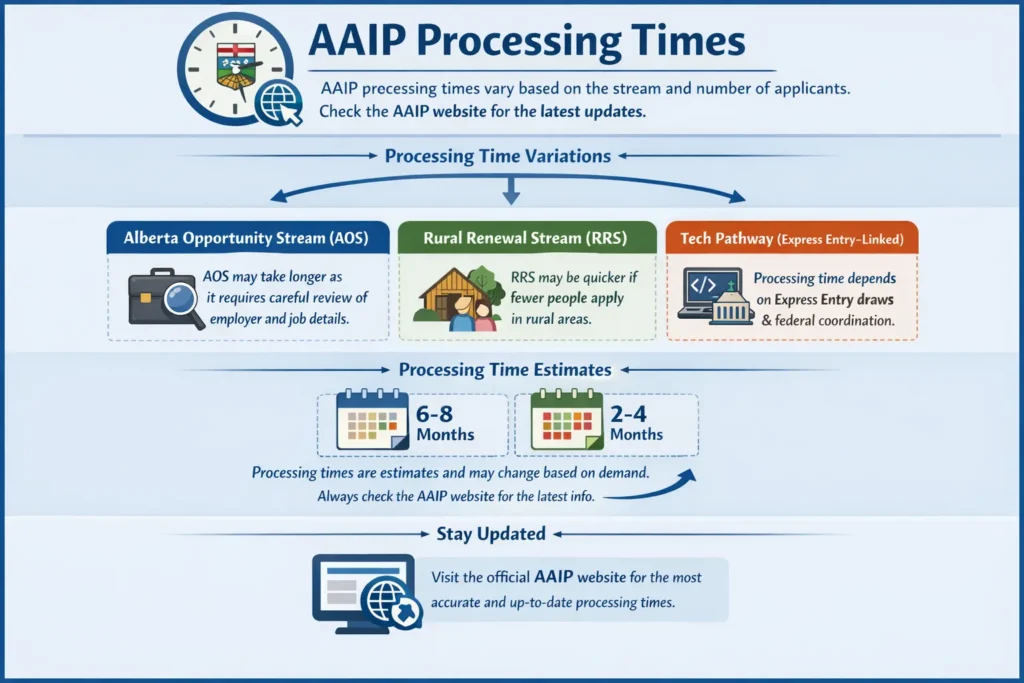
Processing Times Are Different for Each Stream
Alberta Opportunity Stream (AOS): This stream may take longer, as the employer and job details must be carefully reviewed.
Rural Renewal Stream (RRS): This stream can sometimes be quicker if fewer people apply in rural areas.
Tech Pathway (Express Entry–linked): Processing time depends on Express Entry draws and coordination with the federal government. For those interested in this specific route, the Express Entry Stream Alberta offers a unique pathway for candidates with an active profile in the federal pool.
These times are estimates and may change at any time. Every time, check the official AAIP website for the latest and most accurate processing times.
What Happens During AAIP Processing?
When you apply through the Alberta Advantage Immigration Program (AAIP), your application goes through some steps before you get a choice. Every step takes time. Delays can happen if documents are missing, various people are applying, or boss checks take longer.
1: Application Submission
Once you submit your application online, your file is placed in a queue. At this point, no officer has checked your documents, however. Your application is displayed based on the date you applied and the stream you selected. If many people have applied to you previously, the wait may be longer.
2: Completeness Review
Now, officers check if your application is comprehensive. They make certain that all necessary documents are included and legal.
They check:
- All forms are filled out and signed
- Fees are paid
- Language test results are still legal
- Employer documents are included
If something is lost, they will request you to send it. This can delay your application by some weeks.
3: Eligibility Assessment
This is typically the longest step. An officer checks whether you qualify for the program and whether your employer meets the Alberta rubrics.
They look at:
- Your work involvement
- Your job duties
- Your NOC code matches your job
- Your wage meets Alberta standards
- Your employer is actual and appropriate
- Your legal status in Canada (if you are in Canada)
- Employer checks can take more time.
4: Nomination Decision
If everything is in order, AAIP will issue a nomination certificate. If they have worries, they may ask for more info before deciding. Getting nominated helps you move onward to permanent residence.
5: Federal Permanent Residence Stage
Once nominated, you apply for permanent residence with the federal government. Express Entry applicants get 600 additional CRS points and apply online, which is typically the fastest route. Non-Express Entry applicants apply through a separate PR procedure.
It is vital to check current IRCC processing times for the Provincial Nominee Program (PNP) category, as federal timelines can vary significantly from the provincial stage. To stay updated on the latest shifts in federal draws and how they impact provincial nominees, you can follow our news on Express Entry for real-time updates.
Why Processing Times Change
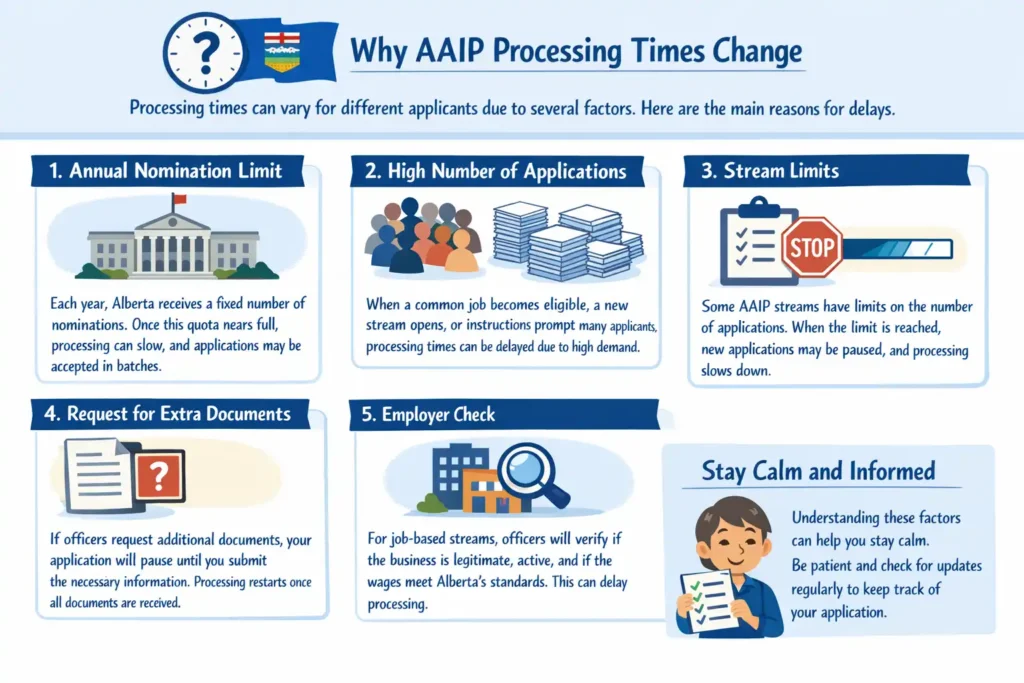
Processing times under the Alberta Advantage Immigration Program (AAIP) vary for everyone. Some people get effects faster, while others wait longer. Many applicants compare their cases with friends’ or online posts and feel concerned. But applications are not always processed in the exact order. Various factors can affect how quickly a file moves. Knowing these causes can help you stay calm.
1: Annual Nomination Limit
Each year, the federal government allocates a fixed number of nominations to Alberta. When this number is nearly full:
- Processing can slow down.
- Applications may be accepted in batches.
- Some files may move to the next year.
2: High Number of Applications
Processing can take longer when:
- A common job becomes eligible.
- A new immigration stream opens.
New instructions make many people apply fast.
3: Stream Limits
Some AAIP streams have an extreme number of applications. When the limit is reached:
- New applications may discontinue.
- Processing may slow down.
4: Request for Extra Documents
If officers, question for more info:
- Your file will pause.
- Processing restarts once you send the documents.
5: Employer Check
For job-based streams, officers check:
- If the business is actual and active.
- If wages meet Alberta standards.
- If the job offer is honest.
Different timelines are usual. Delays frequently occur due to limits, high application volume, or missing documents. Sending complete and accurate information can help avoid delays.
Realistic Timeline Expectations (Scenario-Based)
Processing times can be changed for everybody. They depend on how complete your file is, how many people are applying, and yearly limits. Watching examples can help you know what to suppose. Longer processing does not mean your application will be refused — it typically just reflects the usual workflow.
Scenario 1: Complete Application, Easy Stream
- All documents sent appropriately
- Employer details clear
- Usual stream volume
Processing may happen sooner, near the lower end of the timeline.
Scenario 2: Officer Asks for More Information
- May want an updated language test or job facts
- Application is paused until information is sent
- Review continues once documents are received
Timeline may take a few more weeks.
Scenario 3: Popular Job Category
- Lots of people are applying for the same job type
- Queue may be longer
- Applications reviewed in order
Choice may take longer, to the upper end of the timeline.
Scenario 4: Year-End Backlog
- Alberta nearing yearly nomination limit
- Some files pause in the queue
- Final decision may carry into next year
This is usual timing, not a refusal.
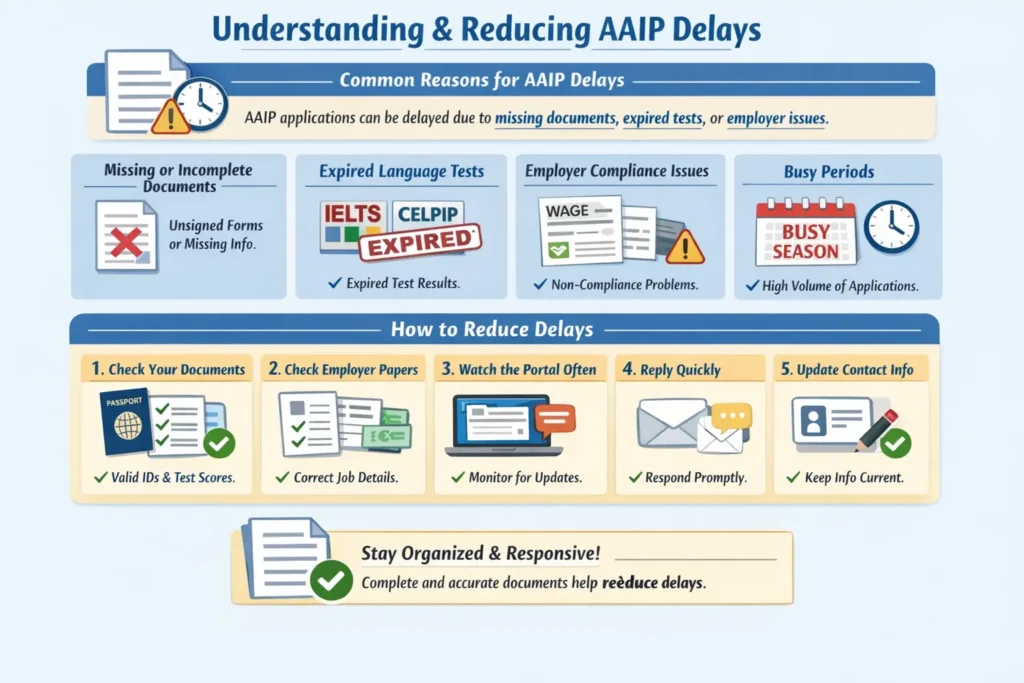
Common Reasons for AAIP Delays
AAIP applications can be delayed for several common reasons. Missing or incomplete documents, such as unsigned forms, missing pay records, or incomplete job facts, can slow things down. Expired language test results, such as IELTS or CELPIP, may also cause delays if new scores are required. Complications with employer compliance, like wages that don’t match provincial instructions, can trigger more checks.
Applications submitted throughout busy times may also take longer to process. Most delays are only part of the review process, not a refusal. Sending complete and up-to-date documents helps your application move more quickly.
How to Reduce Delays
Delays can be annoying, but you can avoid various slowdowns by remaining organized and careful. Keep your documents and communications in order to ensure things move smoothly.
Simple steps to follow:
Check your documents – Make certain your passports are valid, your language tests are correct, and your employment letters match your NOC.
Check employer papers – Ensure wages, job duties, and business details are correct.
Watch the portal often – Search for new document requests habitually.
Reply quickly – Answer requests as soon as you can.
Update contact info – Ensure emails and phone numbers are correct.
These steps help avoid interruptions but don’t expedite approval.
After AAIP Nomination — What Next?
Getting an AAIP nomination does not mean you have long-lasting residence yet. It only means the province has approved you. You still want to apply to the federal government.
After nomination:
Express Entry candidates: Apply for permanent residence through IRCC and get more points.
Non-Express Entry candidates: Apply directly for permanent residence below the Provincial Nominee Program.
Processing time: Federal PR applications can take several months, depending on the type of application.
Remember: provincial nomination ≠ permanent residence. Knowing this helps avoid misperceptions and surprises.
Final Thoughts: What Applicants Should Expect
In short, AAIP applications typically take 4 to 8 months to process, depending on the type and number of applications. The eligibility check takes the most time because officers carefully review your qualifications, employer information, and the rules. Delays are typically due to system factors, such as quotas and verification, not to the applicant. You can stay on track by keeping your documents up to date, checking the portal frequently, replying to requests promptly, and not getting yourself involved with others. Being patient helps, and knowing the steps makes planning easier. Each time, check the official AAIP website for the up-to-date timing.